The Palatine Wall

Ben Williams asked me to write a short piece about the Palatine Wall, to be included in his upcoming update to Jerry Handren’s guidebook Mojave Limestone.

Using the notes app on my phone, I jotted down scattered thoughts that came to me as I drove from Colorado to Sacramento, putting the final touches on the piece during a night alone in Tahoe. Burying myself in nostalgia — that bittersweet blend of pain and pleasure — I revisited not only a special place, but a singular time in my life.

With Ben’s permission, I am reproducing the short piece here:

—

The Palatine Wall
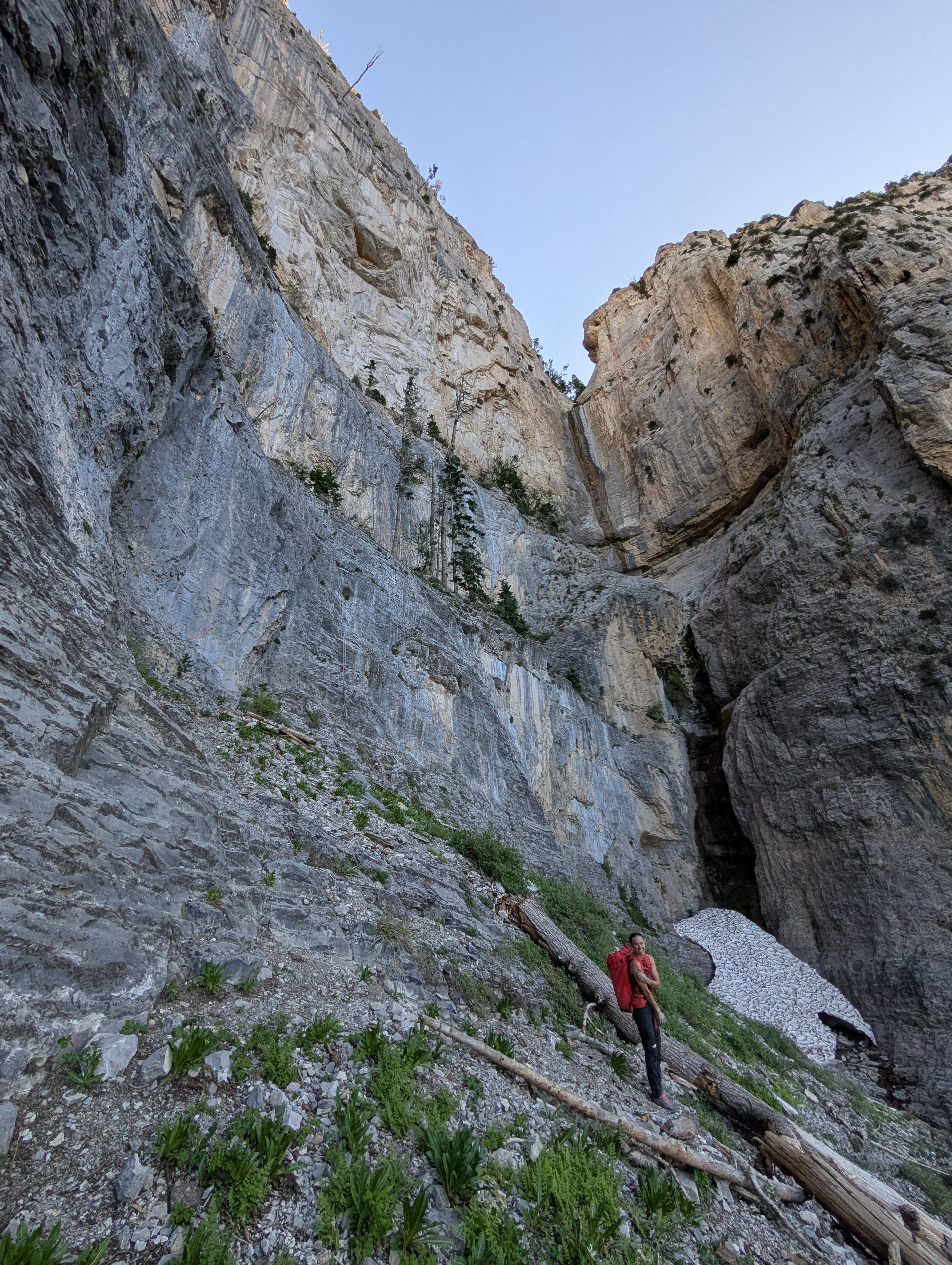
Brette Harrington in front of the mighty Palatine Wall – 2025

In spring 2018, I reconnected with a lanky, blonde, uber-psyched climber at my local crag near Seattle. Tom Moulin ate, slept, and breathed rock climbing, so when he invited me to Vegas that June, I wondered what he knew that I didn’t.

Vegas in June? 

A quick look at the weather showed temperatures in the 90s, even 100s. Surely that was much too hot for even the deepest, darkest canyons in Red Rock, and wasn’t Potosi sunny? 

Just as I was about to text him a screenshot of the forecast paired with one of those shruggy emojis, he beat me to it with a picture of his portable thermometer: 52 degrees. 

Well, damn. I zoomed into the background — fuzzy, thin green lines colored the frame. Wait, were those…pine trees? 

A week or so later, I walked through the sliding doors of the airport and into the unrelenting sun, hair-dryer-style wind blasting across my face. Soon I was behind the wheel of Tom’s small truck, trying to keep his dented old Sprinter in sight as he zipped down the 95. 

Climbing Kyle Canyon Road, the dry-earth, barren-wasteland vibe gradually gave way to Joshua trees, then junipers. By the time we passed the hotel and roundabout, wiry ponderosa pines shot through the sky. 

I’d only seen one photo of the crag, but I recognized it instantly as it flashed into view just before the last hairpin turn. Craning my neck to take it in, I nearly drove clean off the road. 

It looked big and gray, even blue, like something you could find in France. It looked, as we say in the climbing world, mega. 

“I was listening to that History of Rome podcast a lot when I first started coming up here,” Tom told me as we turned off the main hiking trail, the wall looming above everything, impossible to miss. Following a faint footpath up a slight slope, we crisscrossed over fallen, burned logs strewn across our path. The Palatine Hill — the namesake for the wall we were approaching — was one of the most prominent points in ancient Rome, visible to everyone, where emperors built their palaces overlooking the city. 

Apt and clever, I thought, as we reached the base of the wall, perched atop its own small hill, then ascended the low 5th-class terrain that guarded the sheer faces of the upper tier. 

That first day, I climbed Via Appia, a 5.12- that follows creamy blue limestone, passes a fierce boulder early on, and ends on lovely, technical face climbing on bullet rock. It was the first 5.12 I did on Mt. Charleston, and I still consider it to be the best. Then, I set my sights on the  tricky, burly crux of Cursus Honorum, a harder version of Via Appia and just as good. 

In the evening, Tom fell at the very tippy-top of his 50-meter project, Crossing the Rubicon. It was a great day out, and we bounded down the hill at dusk as if we weighed nothing at all — the ponderosas breathing vanilla into the cooling air, phlox blooming a brilliant half-white, half-pink alongside us. 

The following summer, we were stuck in Las Vegas and turned our attention to the Palatine. Tom taught me how to bolt. I started small with Illyria, a bouldery, short route and a nice addition to a cliff otherwise dominated by endurance test pieces. Then, I scoped the attractive gray-blue panel above Tom’s brilliant Lex Julia, what would become Amicus Curiae.  
 
To access a small ledge above the wall, we simul-climbed the complete, two-pitch Via Appia, setting up our respective anchors so we could rappel over our routes-to-be. Before Tom began lowering down over Casus Belli to begin work on Veni Vidi Vici — the clear king line of the wall — he called out to me. 

“Here—” He lobbed a single almond out of the Ziploc bag he was snacking from across the 15 feet of clean air between us. To our surprise, I actually managed to catch it, both of us cheering. I always thought that was a good omen. 
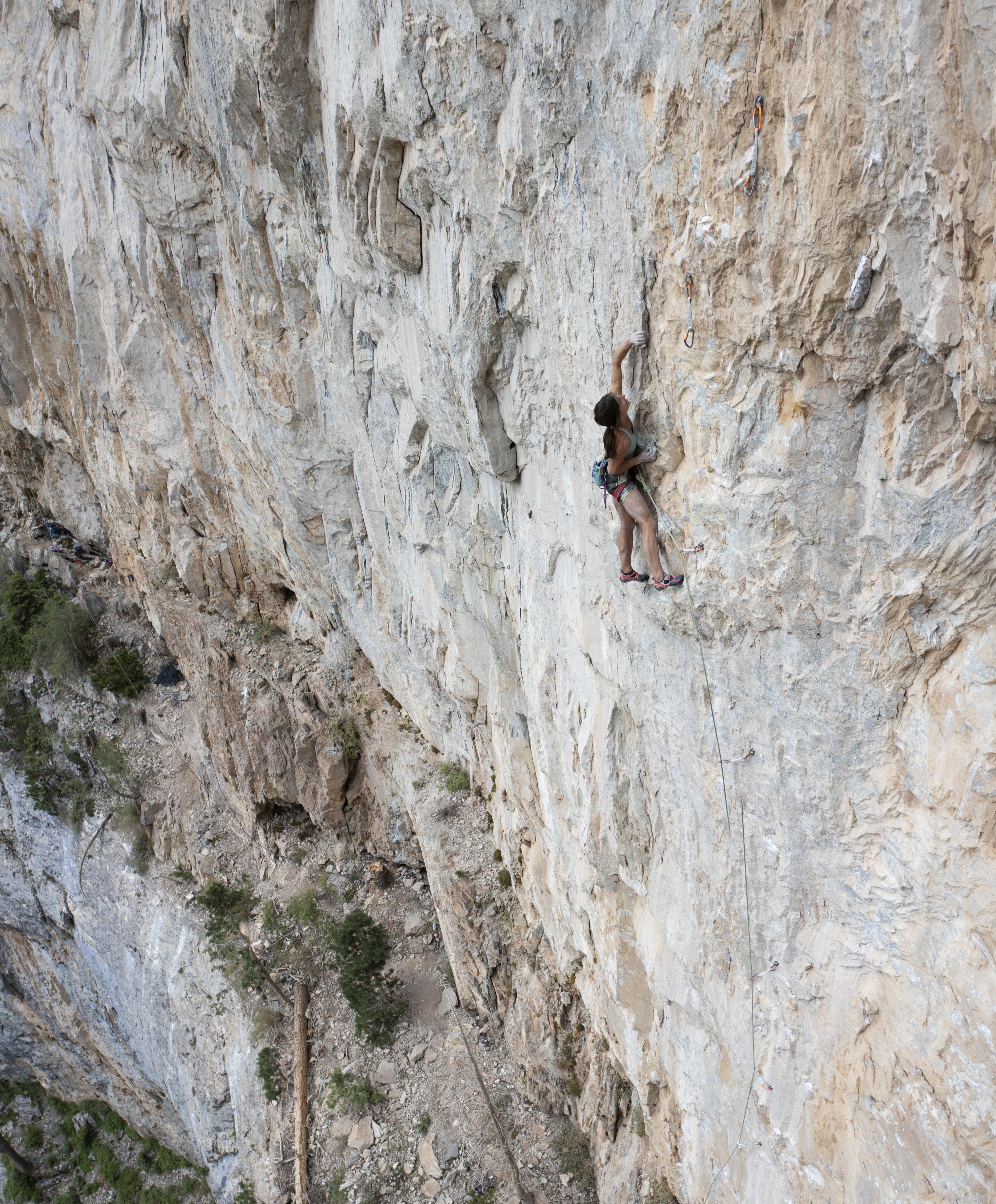
It was a long, hot summer, and the Palatine truly was the coldest cliff around. We fell into a rhythm: climbing on R2C2’s moonboard in the morning, driving to Charleston, then retreating to our fixed lines to work on our respective routes. In between sessions, we’d spend idle time on the large ledge at the base, the scenery and position occasionally slipping me into a sort of reverie. 

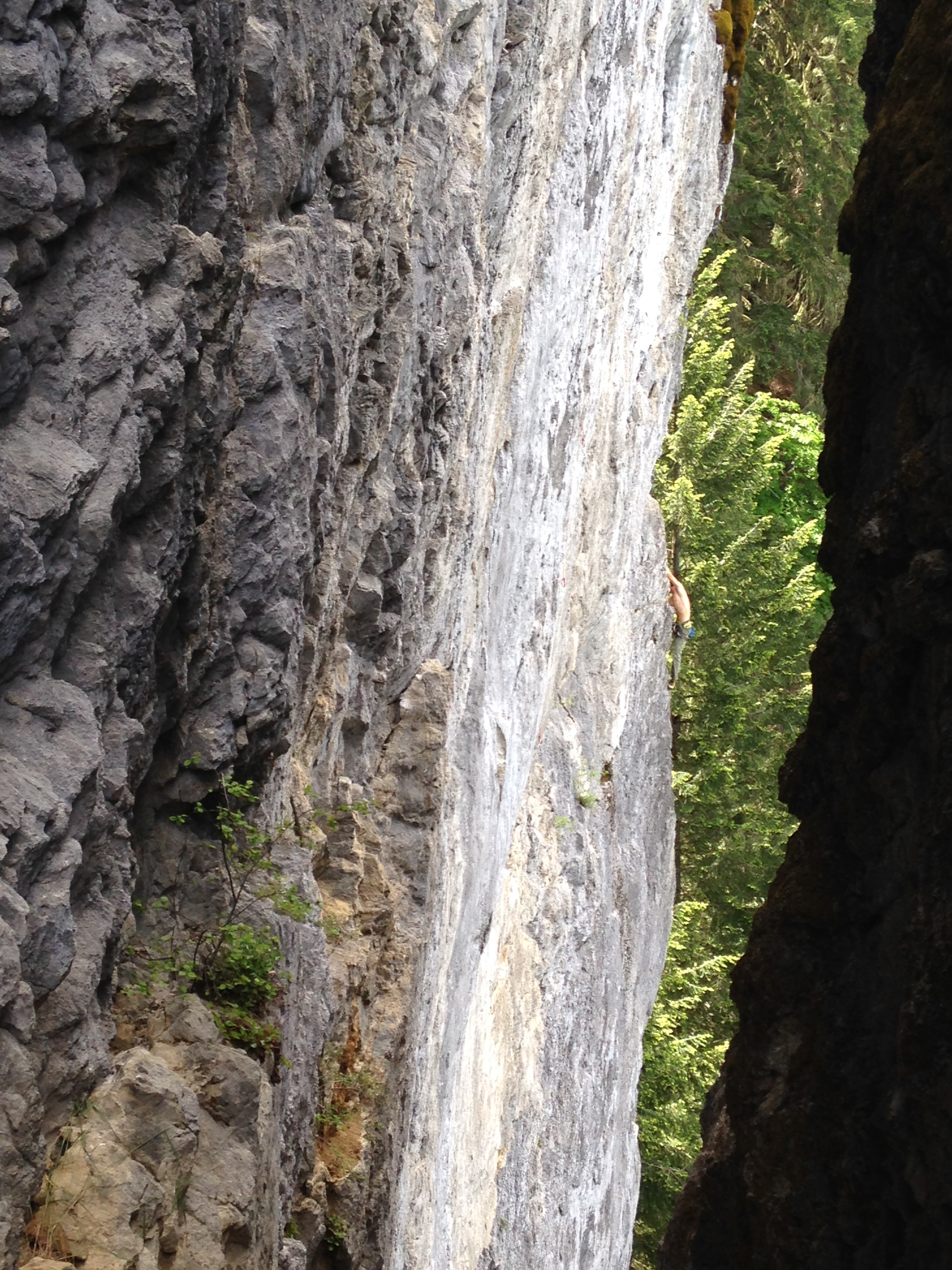
I’ve returned to the Palatine off and on over the years. Even with modest traffic, it’s cleaned up — less chossy, a clean rap line to descend, and otherwise shaping up to resemble a prim and proper sport cliff. Most people like what it offers: remote, yet close to the road; adventurous yet civilized; dishing up everything we love  — a good place to get pumped, try hard, and maybe even find a bit of flow. 

Still, my first impression was a bit overcooked. The Palatine Wall is not mega — it’s very rough around the edges, there aren’t that many routes, they’re all hard and slippery, and you’ll encounter all manner of sport-climbing tricks that make it abundantly clear you’re nowhere near the south of France. 

Even as the Palatine grew familiar to the point of routine — as I turned off the main trail without thinking, knew exactly which hand- and footholds to use as I made my way up from the bottom tier, and dialed in projects and warmups — it still surprised me. Not with anything concrete, like a new feature I hadn’t noticed, but with how a day out climbing there could make me feel: defiant, curious, wild, a sense of potential always stirring as I descended and left the wall for another day.
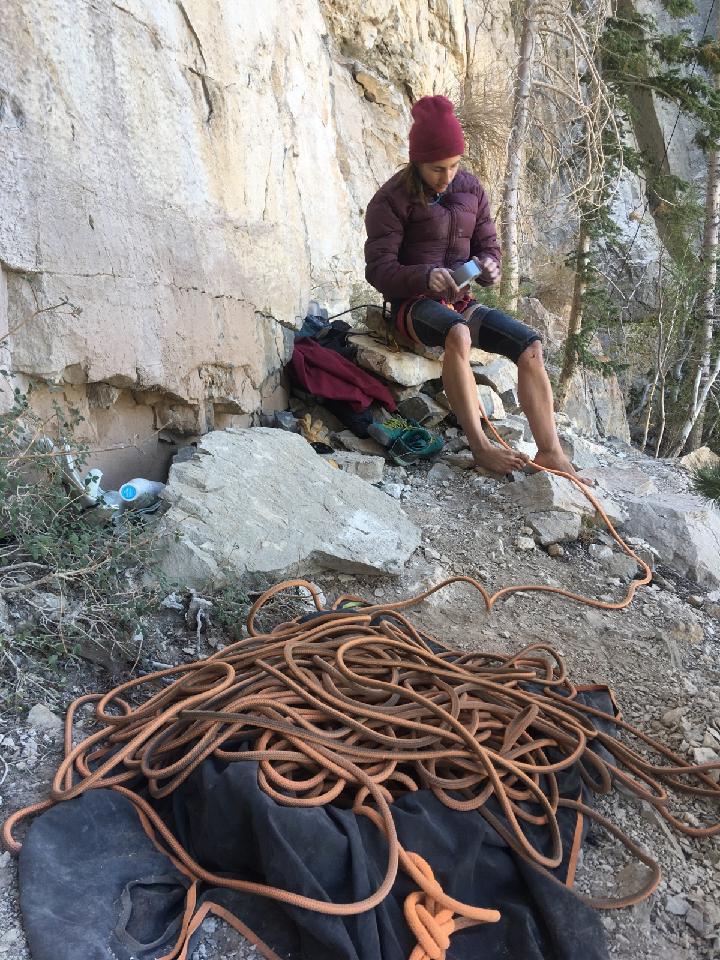
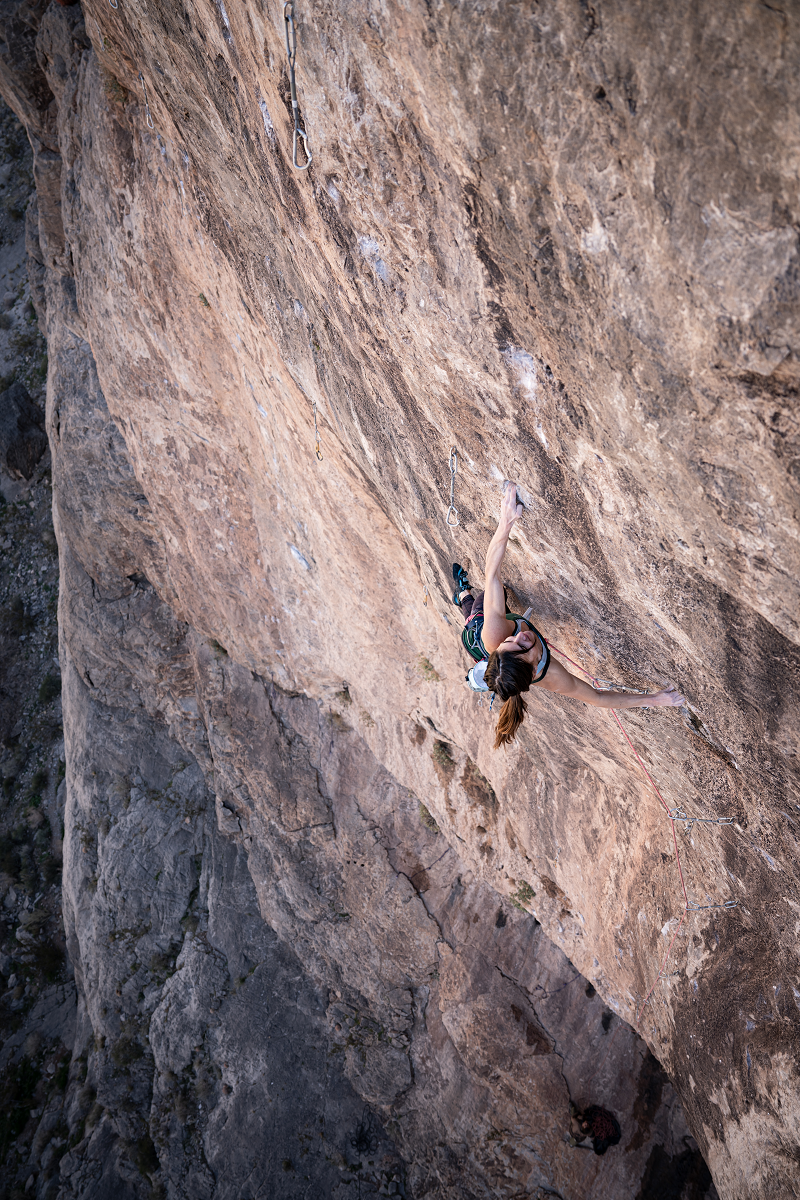
Booting up to give the project a rip – 2021. Photo: Tom Moulin

My Time on Planet Earth

Photo by Rachel Melville

In the middle of winter, I began calling the Virgin River Gorge (VRG) the “Twilight Zone.” The Cambridge Dictionary defines the Twilight Zone as an area where two different ways of life or states of existence meet.

This description came to me on a particularly cold and damp January afternoon. I was sitting on the slab perch beneath the Planet Earth Wall, at the base of Dirt Cowboy, preparing to climb. The temperature hovered around 42 degrees, but, without a breeze, all of us were shedding layers as we climbed.

The VRG draws fame from its juxtaposition—the common refrain jokes that the cliff houses the best limestone in America, but in the worst location. Anyone who has spent time here understands that the VRG’s paradox only begins superficially with its freeway-adjacent location and mind-boggling weather patterns that vary minute-to-minute. In one way or another, the physical contradictions of the place infect your bloodstream and color your experience.

There was a contrast built into the way I approached my climbing day-to-day, and how I considered the season as a whole. For me, my desired outcome seemed completely unimaginable, yet altogether inevitable.

Continue reading “My Time on Planet Earth”

To Bolt or Not To Be

IMG-1504
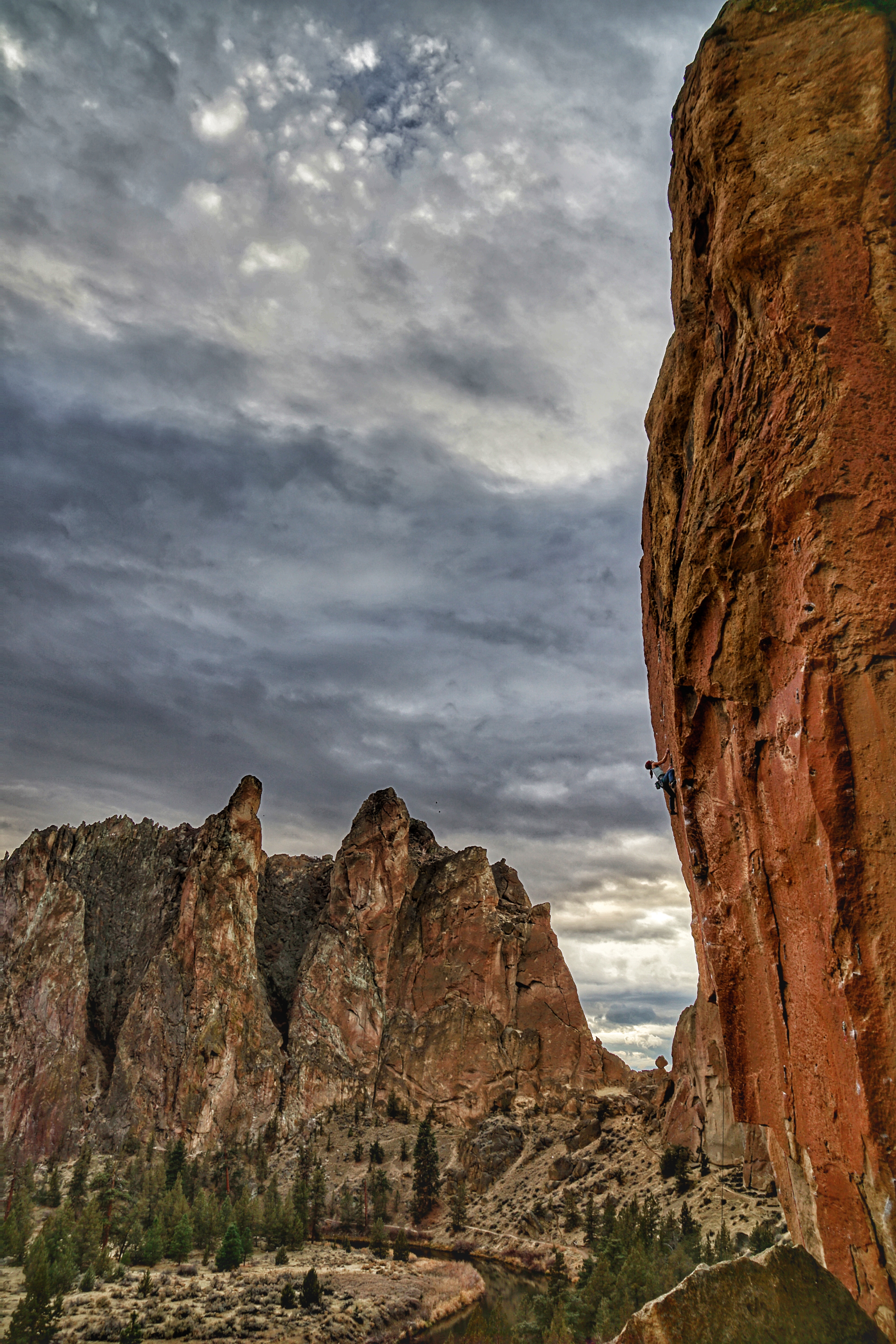
Up high on Kings of Rap at Smith Rock State Park. Photo by Micah Humphrey

On my 27th birthday, I woke up buried in my sleeping bag, nestled in my car in the middle of Central Oregon. I poked my head out to see frost building up on every window of my car, yet the sky was clear and the sun was strong. This wasn’t an unfamiliar scene- I had spent many nights this winter and spring in the exact same spot, and I welcomed the cold weather. Cold weather meant more days of climbing. In fact, the forecast for the week looked so good that I organized my work around it at the last minute,  driving down from Seattle by myself to capitalize on what would likely be the last week of crisp conditions that would grace this area for months.

Continue reading “To Bolt or Not To Be”

“Flow”


Note: This is an old post, whose content was created for fun, with minor proof-reading. Please keep that in mind when reading this post.

“Flow- An optimal mental state of functioning in which our skill matches the challenge, action and awareness merge, and we become so engaged in the activity that we have a loss of self-consciousness and time gets distorted. Full stop”

20161217_114246.jpg

One year ago today I was embarking on the beginning  of what turned out to be one of the best adventures of my life. I traveled from January through mid June finding myself in climbing destinations in California, Utah, Nevada, Arizona, Oregon and Canada. I then moved to Tuolumne (in Yosemite National Park) and had an incredible summer, working all over Yosemite  and spending my days off climbing immaculate granite and exploring the wild places of both the Western and Eastern Sierra. In a quite spur of the moment decision, I ended up climbing in Spain for much of December.

Life was good.

Continue reading ““Flow””

Training Trad

Photos of the Chief near Squamish, British Columbia Canada taken in May 2016.
The granite dome dubbed as “The Chief” hides half of its 700m height on a cloudy day in Squamish, BC, Canada.

“Impossible to go on, impossible to descend impossible to stay where he is. […] With cheek and ear pressed against the canyonland bedrock he feels, hears, shares the beating of some massive heart, a heavy murmur buried under mountains old as Mesozoic time. His own heart. A heavy thick remote and subterranean thumping sound. The fear”

-Edward Abbey

The Monkey Wrench Gang

Note: This is an old post whose content was created for fun, with little to no proof-reading or editing. Please read this post keeping that in mind.

Over the past year I have been pushing aside and ignoring the subtle yet ever-present and stubborn goal of mine to improve at traditional climbing. My excuses were plentiful; I did not have the time to go out to trad crags to improve, I didn’t have the money to gather up a proper rack, what little trad I have done made me good enough (5.8 leader…) for some basic alpine objectives, and crack climbing hurts. In reality, becoming a competent trad leader is a central and essential skill I knew I would have to learn if I were ever to achieve my larger, long-term and more complex goal of becoming a strong and well-versed rock climbing goddess. (Okay, maybe not a goddess.. but just a half decent all-around climber). I want to be able to ascend a feature using a variety of techniques and skills that could only have been garnered by years of experience on different types of rocks and in different styles. My resumé with sport climbing wasn’t so bad, but was seriously lacking with traditional climbing. The fact of the matter is, trad climbing is the TICKET to the alpine, the ticket to some bigger mountains and objectives, and no truly well-rounded rock climber should lack in the ability to utilize a good hand-jam in a splitter crack. I was scared, though. I was scared to fall on gear, scared to take the leap and hesitant to push my trad grade the way I had my sport grade. As the final month of my trip was approaching, though, I knew I would not be able to call it a success if I didn’t spend a concentrated amount of time exploring and growing in this discipline. So, I got my passport and headed to Canada.

I apologize to any non-climbers who have found this blog, because this is a particularly jargon heavy post.

Continue reading “Training Trad”

St George Musings

IMG_4716

“Anyone whose goal is ‘something higher’ must expect someday to suffer vertigo. What is vertigo? Fear of falling? No, Vertigo is something other than fear of falling. It is the voice of the emptiness below us which tempts and lures us, it is the desire to fall, against which, terrified, we defend ourselves.”

– Milan Kundera, The Unbearable Lightness of Being 

Note: This is an old post whose content was created for fun, with little to no proof-reading or editing. Please read this post keeping that in mind.

Since my last blog post my ventures have taken me to a few of St. George’s finest crag, a brief stint in Yosemite, and now to Smith Rock- arguably the birthplace of American sport climbing. Everywhere I go, though, I am trying to maintain my motivation to try as hard as I can, whether that means pushing a new grade, a new type of climbing or just breaking out of my comfort zone to meet new people and explore incredible places. (really , though, I just want to be like all of the crushers I’ve met and “whip off the proj.”)  While on the pursuit of this goal, I have neglected my blog a wee bit..

Continue reading “St George Musings”

The trials and tribulations of a Weekend Warrior

I would rather be ashes than dust!
I would rather that my spark should burn out
    in a brilliant blaze than it should be stifled by dry-rot.
I would rather be a superb meteor, every atom
    of me in magnificent glow, than a sleepy and permanent planet.
The function of man is to live, not to exist.
I shall not waste my days trying to prolong them.
I shall use my time. 

-Jack London

Unknown climber on
Unknown climber on “Visions of Impalement (11d)” at the Trinity Aretes

Note: This is an old post whose content was created for fun, with little to no proof-reading or editing. Please read this post keeping that in mind.

Lately, my ability to squeeze enough satisfaction out of my weekend warrior-ing to keep me content has been waning. Like Jack London, I want to live, though currently I feel as though I am simply existing. Existing between one work day and another, trying to wring out as much pleasure as I can from my brief trips to the mountains as possible.

Perhaps this sounds over-dramatic, but I didn’t always feel like this.  In fact my first month here all I wanted to do was stay in the city and explore my surroundings.  However, those were some strange times while I was battling changes in life that demanded my mental attention. I also was living in Bishop, CA where I was surrounded by endless outdoor recreation possibilities. Now that life has calmed down a little bit and my scenery has changed, the climbing spark has been reignited. I can trace this back, actually, to a series of weekends I spent sport climbing in the Trinity Aretes.

Continue reading “The trials and tribulations of a Weekend Warrior”

Mosoraški

IMG_2689Note: This is an old post whose content was created for fun, with little to no proof-reading or editing. Please read this post keeping that in mind.

What to do during our last day in Croatia was a topic of considerable debate. Should we go for something big and hard, or would we be too tired to make it safely to the airport early the next morning? Taking it easy posed the risk of squandering what very likely would be out last opportunity to climb in Paklenica. Ah, the tough problems of traveling climbers.

In the end, we decided on a compromise- we would climb a long, classic but easy route. That way we wouldn’t be trashed, could move quickly in order to have the afternoon dedicated to packing and traveling toward Zagreb (where we both had flights out the next morning) but still could feel like we parted with Paklenica in a meaningful way.

On that last day, the weather was beautiful as we made our way for the last time up the cobblestone path toward Anića kuk Kuk. Thirty minutes later we were getting ready below the legendary huge carabiner which marks Paklenica’s most popular route-Mosoraški(6a+, 10c.)

Continue reading “Mosoraški”

Climbing near Sarajevo- Dariva

Note: This is an old post whose content was created for fun, with little to no proof-reading or editing. Please read this post keeping that in mind.

Sarajevo is a city of contrasts, a city marked by both tolerance and neglect.  Tattered buildings still carrying the scars of war sheepishly face modern out of place buildings glowing at night. The call to prayer rings out from minaretes scattered along the city as others enter synagogues or churches. Apartments are kept tidy and neat while trash floods the street. A small limestone crag filled with motivated climbers lies minutes from an ancient bazaar. Sarajevo was my first stop. IMG_2361 Continue reading “Climbing near Sarajevo- Dariva”

The Triple Crown

Note: This is an old post whose content was created for fun, with little to no proof-reading or editing. Please read this post keeping that in mind.

Accidents in the mountains are less common than in the lowlands, and these mountain mansions are decent, delightful, even divine, places to die in, compared with the doleful chambers of civilization. Few places in this world are more dangerous than home. Fear not, therefore, to try the mountain-passes. They will kill care, save you from deadly apathy, set you free, and call forth every faculty into vigorous, enthusiastic action. – John Muir

In Tuolumne Meadows, there are no shortage of routes available to the motivated climber. Three of these routes make up what is known as the “Triple Crown”- Tenaya Peak, Cathedral Peak, and Matthes Crest. All three routes get you above 10,000 ft. for a moderate grade, and all are unique in their own way. The strongest and quickest climbers try to link them up in a day, which is an ambitious task. Emmanuel and I wanted to climb all of them, but honestly thought we would have to pick one or two of them. Well, turns out we didn’t.

Our plan was to head into Tuolumne from Lone Pine, sleep outside of the park and then climb Tenaya on Thursday morning. After Tenaya we planned to try to get a permit to backpack into Echo Lakes on Friday. As Cathedral Peak and Matthes Crest are about 2 miles from another (and both close to Echo Lake), many link the two routes in two days by backpacking to Echo Peaks. This lets you avoid having to hike back and forth and also to sneak in some backpacking in the middle of climbing two classics.

So, in three days we climbed the three most prolific “easy” routes in Tuolume meadows, Here, then, is what happened along the way…

IMG_2031

Continue reading “The Triple Crown”