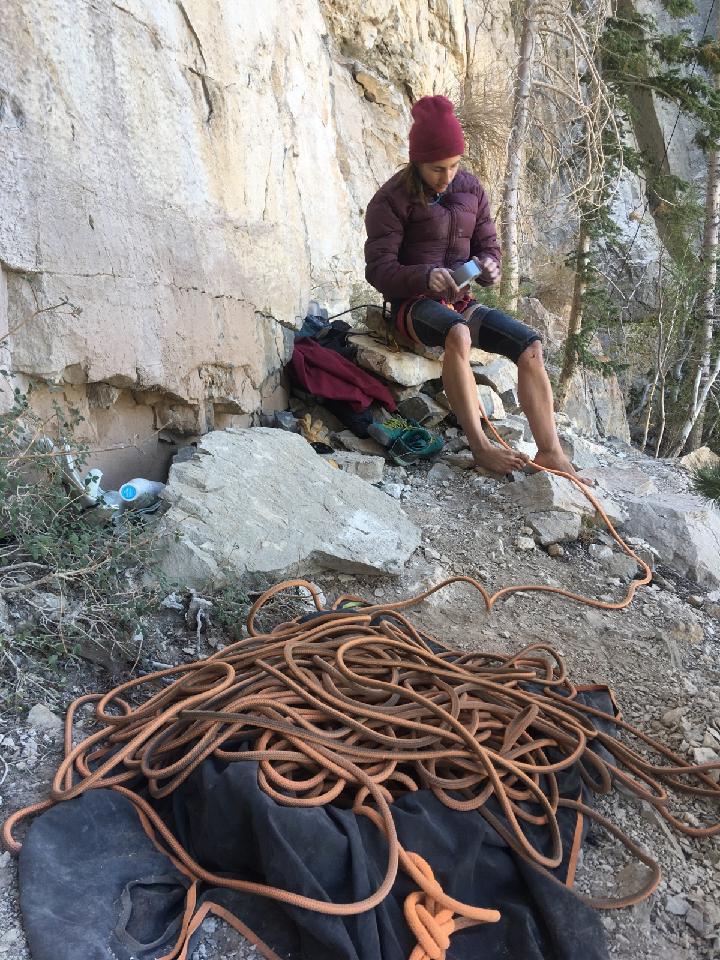
Ben Williams asked me to write a short piece about the Palatine Wall, to be included in his upcoming update to Jerry Handren’s guidebook Mojave Limestone.
Using the notes app on my phone, I jotted down scattered thoughts that came to me as I drove from Colorado to Sacramento, putting the final touches on the piece during a night alone in Tahoe. Burying myself in nostalgia — that bittersweet blend of pain and pleasure — I revisited not only a special place, but a singular time in my life.
With Ben’s permission, I am reproducing the short piece here:
—
The Palatine Wall
In spring 2018, I reconnected with a lanky, blonde, uber-psyched climber at my local crag near Seattle. Tom Moulin ate, slept, and breathed rock climbing, so when he invited me to Vegas that June, I wondered what he knew that I didn’t.
Vegas in June?
A quick look at the weather showed temperatures in the 90s, even 100s. Surely that was much too hot for even the deepest, darkest canyons in Red Rock, and wasn’t Potosi sunny?
Just as I was about to text him a screenshot of the forecast paired with one of those shruggy emojis, he beat me to it with a picture of his portable thermometer: 52 degrees.
Well, damn. I zoomed into the background — fuzzy, thin green lines colored the frame. Wait, were those…pine trees?
A week or so later, I walked through the sliding doors of the airport and into the unrelenting sun, hair-dryer-style wind blasting across my face. Soon I was behind the wheel of Tom’s small truck, trying to keep his dented old Sprinter in sight as he zipped down the 95.
Climbing Kyle Canyon Road, the dry-earth, barren-wasteland vibe gradually gave way to Joshua trees, then junipers. By the time we passed the hotel and roundabout, wiry ponderosa pines shot through the sky.
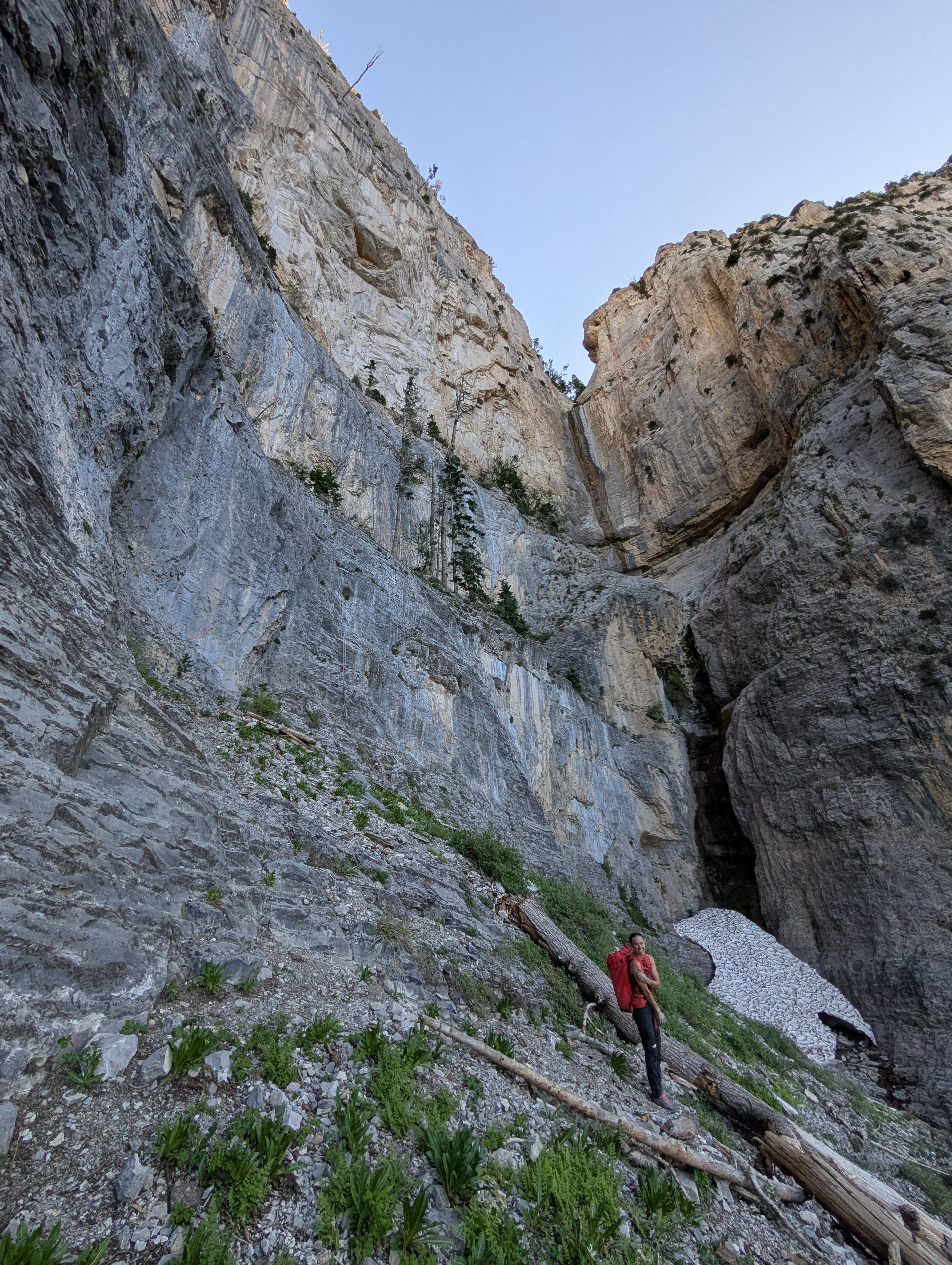
I’d only seen one photo of the crag, but I recognized it instantly as it flashed into view just before the last hairpin turn. Craning my neck to take it in, I nearly drove clean off the road.
It looked big and gray, even blue, like something you could find in France. It looked, as we say in the climbing world, mega.
“I was listening to that History of Rome podcast a lot when I first started coming up here,” Tom told me as we turned off the main hiking trail, the wall looming above everything, impossible to miss. Following a faint footpath up a slight slope, we crisscrossed over fallen, burned logs strewn across our path. The Palatine Hill — the namesake for the wall we were approaching — was one of the most prominent points in ancient Rome, visible to everyone, where emperors built their palaces overlooking the city.
Apt and clever, I thought, as we reached the base of the wall, perched atop its own small hill, then ascended the low 5th-class terrain that guarded the sheer faces of the upper tier.
That first day, I climbed Via Appia, a 5.12- that follows creamy blue limestone, passes a fierce boulder early on, and ends on lovely, technical face climbing on bullet rock. It was the first 5.12 I did on Mt. Charleston, and I still consider it to be the best. Then, I set my sights on the tricky, burly crux of Cursus Honorum, a harder version of Via Appia and just as good.
In the evening, Tom fell at the very tippy-top of his 50-meter project, Crossing the Rubicon. It was a great day out, and we bounded down the hill at dusk as if we weighed nothing at all — the ponderosas breathing vanilla into the cooling air, phlox blooming a brilliant half-white, half-pink alongside us.
The following summer, we were stuck in Las Vegas and turned our attention to the Palatine. Tom taught me how to bolt. I started small with Illyria, a bouldery, short route and a nice addition to a cliff otherwise dominated by endurance test pieces. Then, I scoped the attractive gray-blue panel above Tom’s brilliant Lex Julia, what would become Amicus Curiae.
To access a small ledge above the wall, we simul-climbed the complete, two-pitch Via Appia, setting up our respective anchors so we could rappel over our routes-to-be. Before Tom began lowering down over Casus Belli to begin work on Veni Vidi Vici — the clear king line of the wall — he called out to me.
“Here—” He lobbed a single almond out of the Ziploc bag he was snacking from across the 15 feet of clean air between us. To our surprise, I actually managed to catch it, both of us cheering. I always thought that was a good omen.
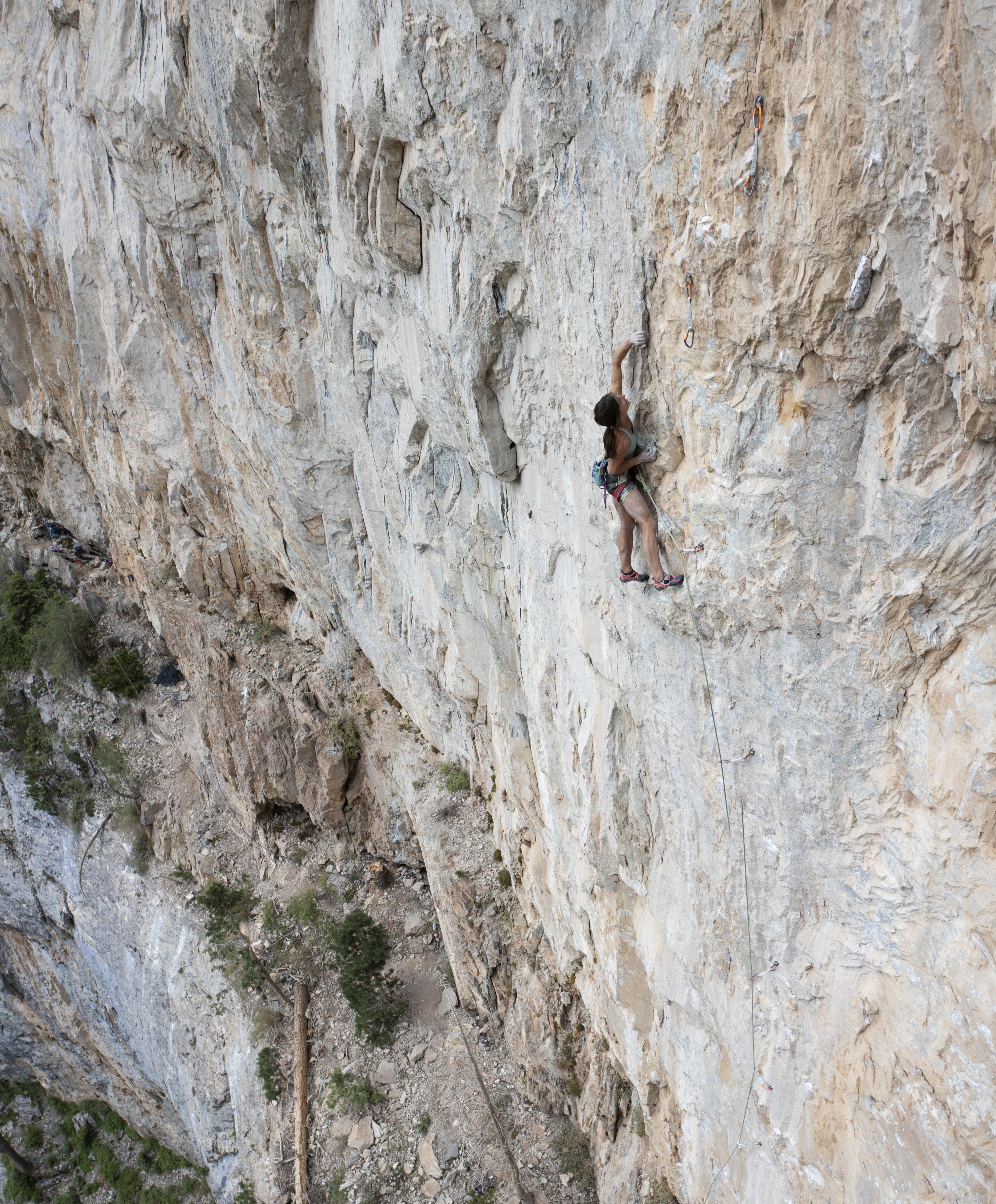
It was a long, hot summer, and the Palatine truly was the coldest cliff around. We fell into a rhythm: climbing on R2C2’s moonboard in the morning, driving to Charleston, then retreating to our fixed lines to work on our respective routes. In between sessions, we’d spend idle time on the large ledge at the base, the scenery and position occasionally slipping me into a sort of reverie.
I’ve returned to the Palatine off and on over the years. Even with modest traffic, it’s cleaned up — less chossy, a clean rap line to descend, and otherwise shaping up to resemble a prim and proper sport cliff. Most people like what it offers: remote, yet close to the road; adventurous yet civilized; dishing up everything we love — a good place to get pumped, try hard, and maybe even find a bit of flow.
Still, my first impression was a bit overcooked. The Palatine Wall is not mega — it’s very rough around the edges, there aren’t that many routes, they’re all hard and slippery, and you’ll encounter all manner of sport-climbing tricks that make it abundantly clear you’re nowhere near the south of France.
Even as the Palatine grew familiar to the point of routine — as I turned off the main trail without thinking, knew exactly which hand- and footholds to use as I made my way up from the bottom tier, and dialed in projects and warmups — it still surprised me. Not with anything concrete, like a new feature I hadn’t noticed, but with how a day out climbing there could make me feel: defiant, curious, wild, a sense of potential always stirring as I descended and left the wall for another day.