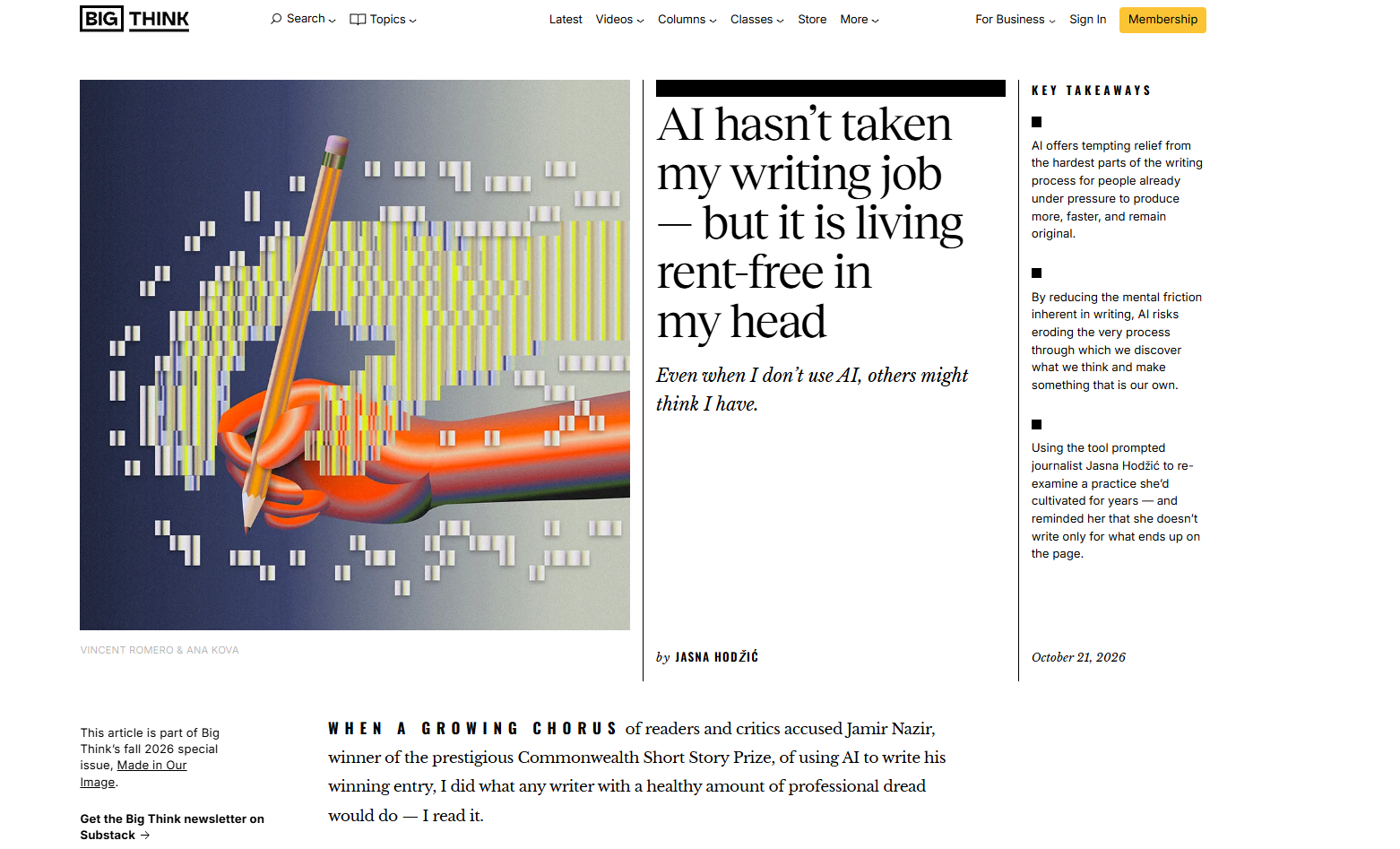
This summer, Big Think asked me to write a piece for its upcoming quarterly print magazine. Each issue brings together pieces around a shared theme. This one, “Made in Our Image,” explored our relationship with AI. The editors comissioned me to discuss how AI has changed the experiece of writing, and how the technology has impacted my identity as a ‘writer,’ (an identity I’m not sure I have ever adopted).
I said “sure,” – since I’d been non-stop complaining about AI for months, I figured I’d have a whole lot to say. Then, I sat down to write, and struggled for much of July. I would spend entire days writing pages of paragraphs, only to return to the document later that night and erase eerything I wrote. I’d lay in bed totally spent, mentally exhausted, weighed down by two heavy conclusions: First, that my writing day was totally pointless, and second, that I’m a fraud and an idiot.
Of course, all that friction was evidence that I had no idea how I really felt about the topic. Working through it gave me the opportunity to organize my thoughts, recognize the patterns beneath them — those things we call opinions and emotions — and understand my behavior, and myself, a little better. Of course, I only came to these conclusions afterward. In the moment, I had to fight against the urge to email my editors and quit.
Ironically, despite how desperately I wanted to escape the process, I came away with a begrudging acknowledgment that outsourcing the hard parts to AI might offer some immediate relief, but wouldn’t make the harder work of figuring out what I think any easier. Outsource your writing, outsource your thinking, your agency. The slope grows steeper and more slippery with every new prompt.
You can find the story here, and in Big Think’s print magazine.
If you read it, please let me know what you think.

