“If people were silent about the things that had happened to them, was something not being betrayed, even if only the version of themselves that had experienced them?” – Rachel Cusk

FEBRUARY 2024
ARIZONA
Virgin River Gorge (VRG)
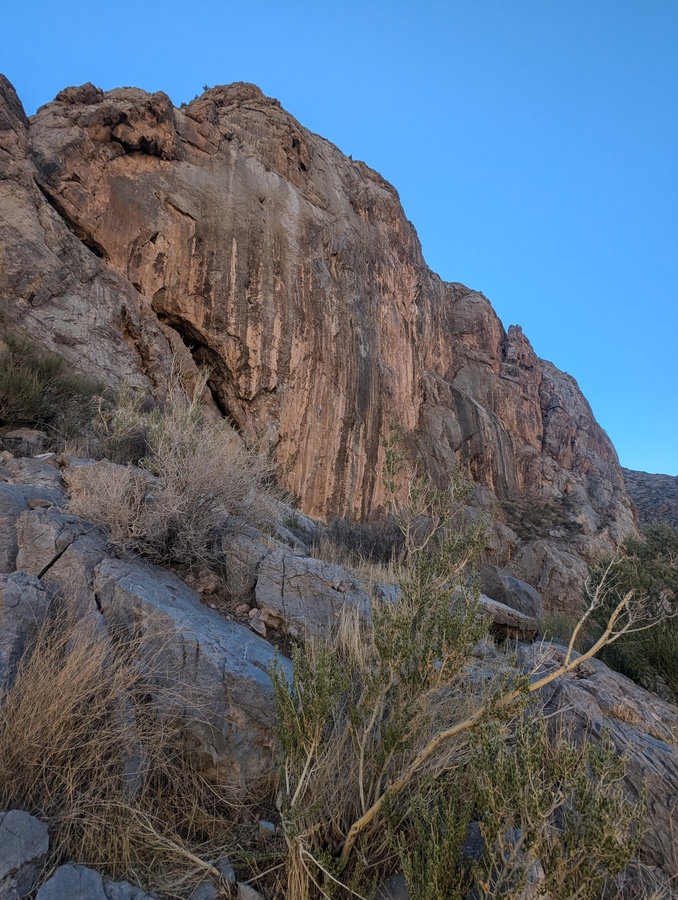
There’s a specific bend on the trail where, if you know to look up, you’ll catch the tallest point of the Blasphemy Wall. A few more steps, and its entirety rises suddenly from the ground, like a challenge. I always stop here, just for a moment.
By now, I’ve honed a routine: music on, stick-clip the second bolt, walk out to the slab that juts over the highway below. From there, I look at the route. I take my hands out of my jacket, let the cold air harden my skin. Sometimes, I mime a move or two.
The crux of Atonement came early for me—move eight. A lock-off from a right-hand microcrimp that chews into my skin and a left-hand “emotional support hold”: nothing more than an indentation in the wall, but just enough to get my hips where they need to be. Then, a deadpoint to a left-hand sidepull—body tension at its finest, a razor-thin margin between too taut and too loose. When I’m on form, my right foot holds, and my left cuts. When I’m not, I sag too far from the wall before I latch the hold, and I’m off.
For the last few sessions in a row, I couldn’t stick this move—not from the ground, not even in isolation. I’d climb from the very next move to the top on autopilot, but that didn’t mean much if I couldn’t hit the crux.
It’s the worst case of the “VRG lifecycle” I’ve experienced. You make quick progress. Then, you slowly start regressing. Some combination of thin skin, finicky conditions, and a defeated morale all combine to take you from “Next go for sure,” to “not my best day,” to “fuck this place.” Like some complex insect, you have to molt through dozens of near-deaths to finally emerge as the beautiful, sendy butterfly. Mostly, it’s demoralizing. But if you can catch that moment–if you can climb with the kind of focus it demands–I’ve not quite found anything like it.
December moved to January. Then February. The sun was inching toward the wall, ready to shut the season down.
After a few minutes, I walk from the slabs to the base of the route and tie in.
Shoes on, jacket off, music paused.
I go for it.
I don’t stick it.
I lower and sit at the base, still tied in. I’ll go again in five minutes.
My shoes half on, the heels sticking out for air.
MAY 2024
BISHOP – CEUSE
The travel was brutal.
I don’t know if my friend really understood how miserable I was—I got carsick on the drive from Bishop to Vegas, motion sick on the flight from Vegas to Denver, and again from Denver to Munich. The cumulative fatigue left me weak. She strolled past me in the airport with a bemused smile, which, honestly, helped. One step at a time, vision trained on a point in the distance.
It took everything I had just to keep walking, to make the connecting flights we had to hustle for, one after another. I didn’t want to be the one to fuck it up—this entire trip was my idea, and I was arguably the more experienced one. But I felt so, so wretched.
I was meant to drive—the only one who could drive a stick—so I did. We had to get some food, so we went where Google said, and I cursed myself for leading us to what was essentially a mall. I love many things about the European way of life, but this wasn’t an idyllic walk across a cobblestone street to a decadent, quaint boulangerie. This was a fight to find a parking spot, a struggle to get the euro coin into the locked grocery cart, and then, a grocery store… inside a mall. Really?
When we finally got to our Airbnb—after a prolonged battle to identify, and then to open, the front door—I collapsed into bed, absolutely wasted. Sleep dragged me under completely, heavy and irresistible.
I woke up early—jet lag—to the sound of rain, the smell of it weighed with a life and humidity I hadn’t felt in months.
I walked outside to our small porch and stretched my arms. When I turned around, the famous cliff line confronted me, stretching along the horizon like a brushstroke, both understated and breathtaking.
And there it was: that reliable thrum of energy, returning to me.
JUNE 2024
FRANCE
Céüse
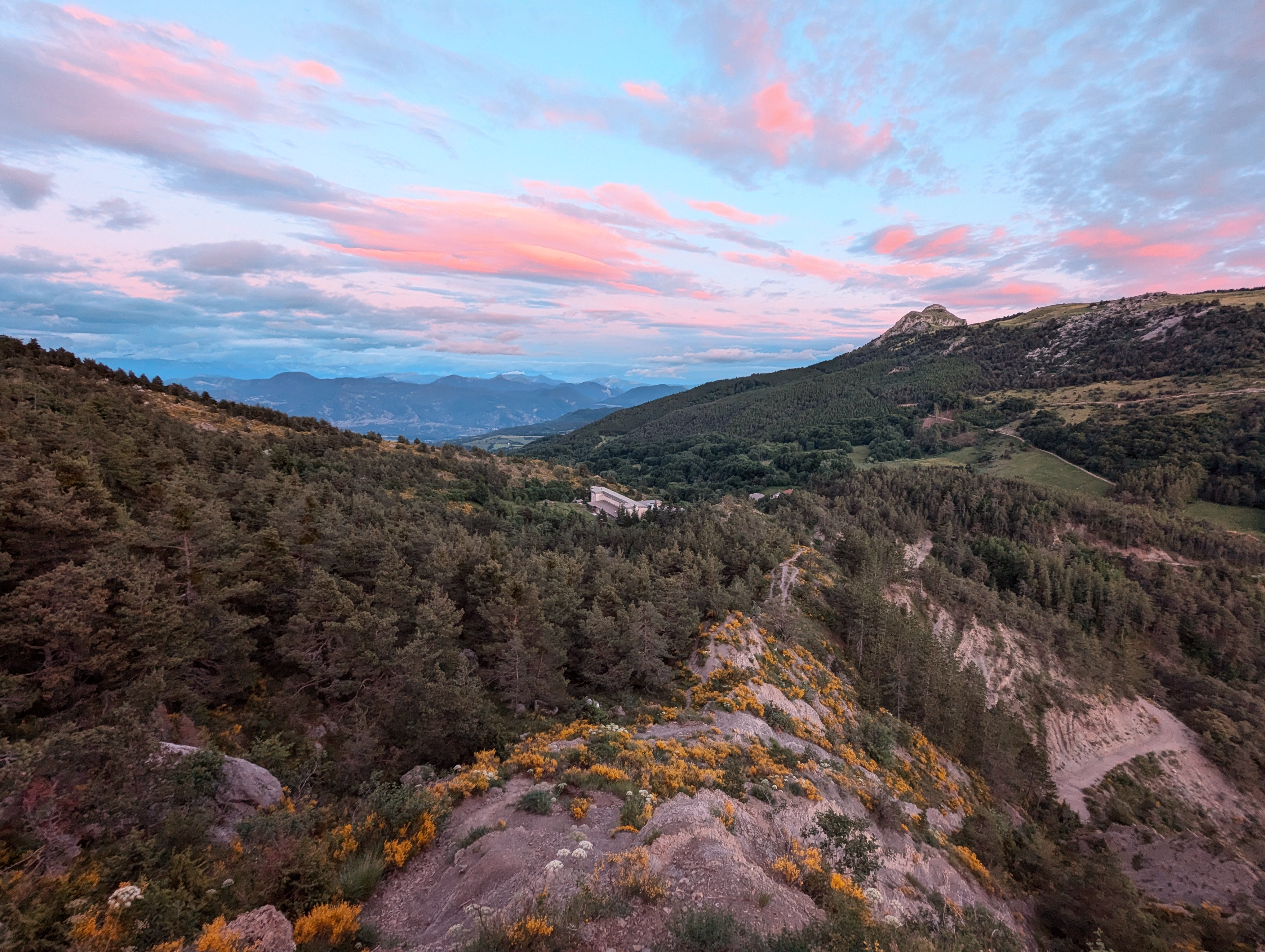
For me, the climbing was both difficult and effortless. The physical movements were demanding, but the sequences revealed themselves as I moved. I instinctively knew how to adjust my hips, how to grip a shallow dish, how to balance on a slick foot. And because I understood, the infamous runouts—those wide gaps between bolts people warned me about—didn’t unsettle me as much as I’d expected.
Everyone complained about the hike, but it usually felt like a gift. It became something of a ritual, a time for me to transition from one state of mind to another.
Brilliant yellow Scotch Broom hugged the edges of the trail. Pale orange poppies scattered the hillside, and spindly white carrot flowers stretched into the sky on their thin, bending stalks. Clouds were almost always present—sometimes low and threatening, other times high and wispy, dissolving into the blue.
I’d put on music and retreat into my head. The right song could transform anything, engulfing even the heaviest weight—mental, physical, emotional—in the sheer potential of the day. It felt like possibility swelled inside me, straining to shift from thought into action.
I was 33 and knew myself well enough to recognize this tendency: pulling meaning from meaningless things, getting lost in compulsive loops of reckoning. At home, I tried to tamp it down, to live a little more sensibly. Don’t get any big ideas, I’d tell myself. For some reason, here, I let myself sink into it completely.
My world of illusion, of thoughts.
By the time I reached the summit, I was hiking much more quickly than I should have been, if energy conservation for the day ahead were a priority. Out of breath, heart rate up, legs burning. But, I was also buzzing, feeling my energy pouring out and billowing ahead of me. Like I was living my largest life.
On that final stretch, the climbers already at the cliff came into view, resting under its shaded edge. I noticed their gazes lingering on me, watching as I approached. Normally, even the idea of attention—real or imagined—would leave me tense and self-conscious. But here, for some reason, I welcomed it. I absorbed what I perceived to be their quiet acknowledgment.
And the entire landscape—that in front of my eyes, and that inside of my head—felt like an invitation to shed any pretense.
I was too much. I felt too much. I talked too quickly, had too much energy, always tried too hard to make people laugh. I tripped over my attempt to be witty more often than not. And yet, I reveled in the quickness of my thoughts, the way my brain was working—like sculpting something out of clay. Occasionally, I’d nail it: I could take an unremarkable moment, connect it with something seemingly unrelated, and spin it into an intricate and surprising observation. And sometimes, someone would catch it—just as I’d hoped. When that happened—with literally anyone—it felt like passing an electric current between us, cracking open a private world.
I’m an atheist, but sometimes I felt as though I was tapping into something spiritual. I felt received.
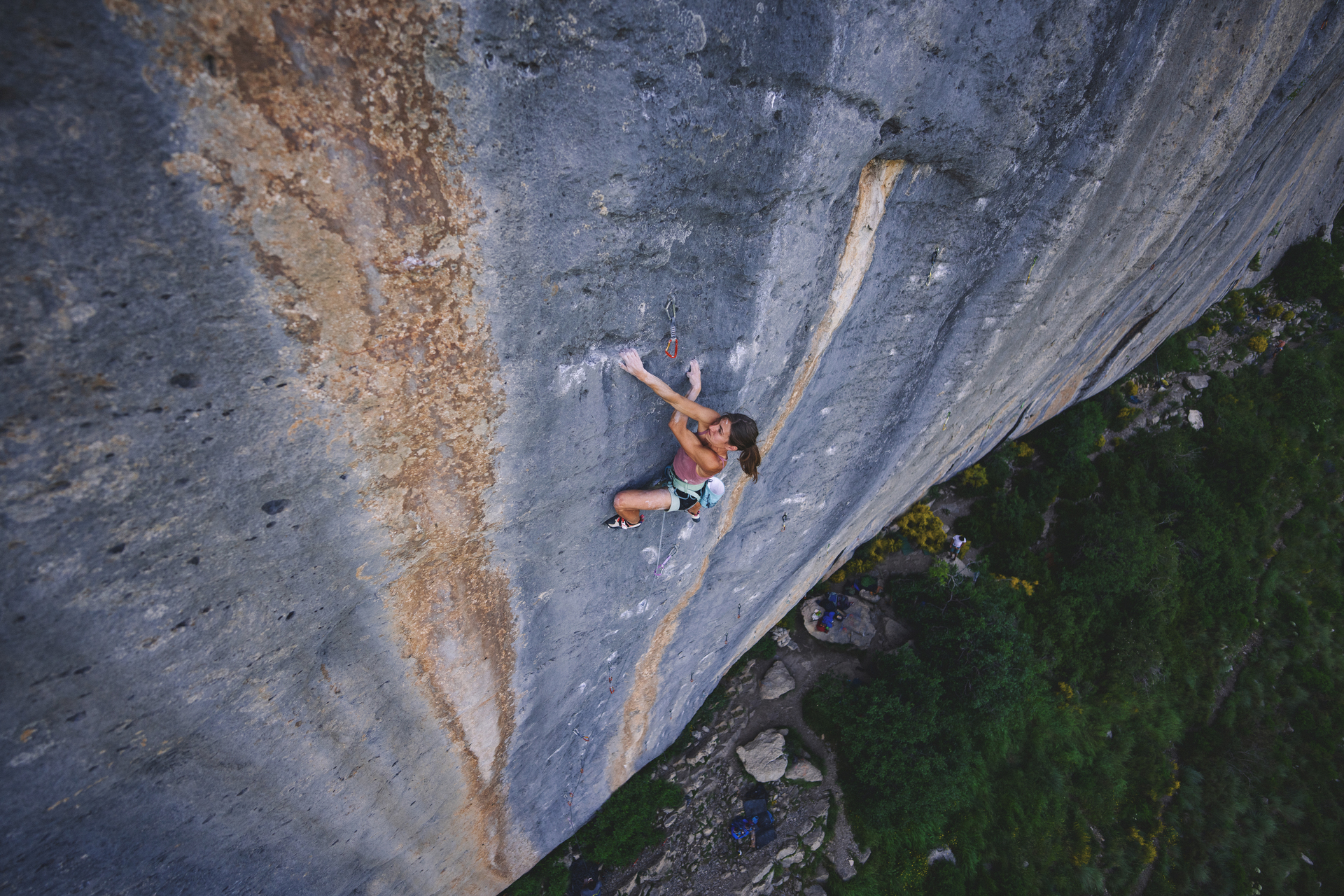
And then there was the world of action, the reality as sweet.
I climbed many new routes from 7a to 8b—none of them taking me more than a handful of tries. Le Chirurgien du Crépuscule. Femme Blanche. Femme Noire. Le Poinçonneur des Lilas. Face de Rat. Couleur de Vent. Petit Tom. Blocage Violent, Changement de look… Every one like poetry.
We climbed until the sun dipped behind the horizon and hunger and exhaustion took over. I often imagined what we must have looked like from above as we hiked back—the pinpoints of our headlamps snaking down the hillside. We’d tell stories and play verbal games to pass the time. Dinner was late—11 PM or even midnight, often paired with wine. I woke up at nine or ten, fell into my thoughts on the hike, ate a pastry as I rested below the cliff, and climbed with a flow that felt almost otherworldly.
Over the next five weeks, my climbing continued to show up for me. I knew what I was doing wasn’t anything extraordinary—especially at a cliff where the line for Biographie was several climbers deep. But I noticed the difference between how I climbed before, and how I was climbing now.
I was moved by my own performance, and it became a window into myself—the spaces I could go, the emotions I was capable of, the clarity of thought I could access. It felt novel and exciting, but I couldn’t deny it carried a sense of quiet nostalgia, like encountering an old friend you hadn’t thought of in years—an instant recognition, a gentle ease of being.
And maybe this is where it began.
That dose of confidence from climbing surfaced certain truths I hadn’t realized were there. I’d go for walks and consider my life at home, and a peculiar sensation came over me. Conversations, choices, interactions, they all felt different, like they weren’t mine. I hadn’t noticed, but over the last several years, I really had been falling apart.
I thought about the silent compromises I’d made. The moments of unawareness I’d let myself slide into. The times I’d deliberately chosen not to feel compassion for myself, not to make an effort to understand so as to remain comfortably oblivious. Now, the very things I’d ignored were forcing my hand, demanding to be known. There was something darkly fitting about it all.
Here, I found quality of living and thinking I that I couldn’t walk away from—not without losing something I perceived to be essential. But, I wanted to anchor this sensation to something more tangible. I wanted proof that I wasn’t losing my mind or about to act with a reckless urgency I’d regret. I needed to understand what was driving the shift inside me, but it was like trying to catch smoke—fleeting, elusive, impossible to pin down and even know it’s real. Of course, I couldn’t. Instead, I had to trust myself.
Still, I assumed I was probably exaggerating, mistaking this state to be more expansive, more lasting, more real than it was. It felt too romantic, too frantic. Yet I leaned into it—not because I was sure of it, but because it offered a seductive and irresistible possibility: a different way of living in the world. A different way of living with myself.
During the twenty-hour trip home, I deluded myself into thinking I was weighing my options, as if I hadn’t already made up my mind.
Each hour brought me closer to a rupture that I knew would violently unravel both my real life and this delicate, ethereal state.
Leaving me with what, I wondered.
JULY 2024
CALIFORNIA
Bishop
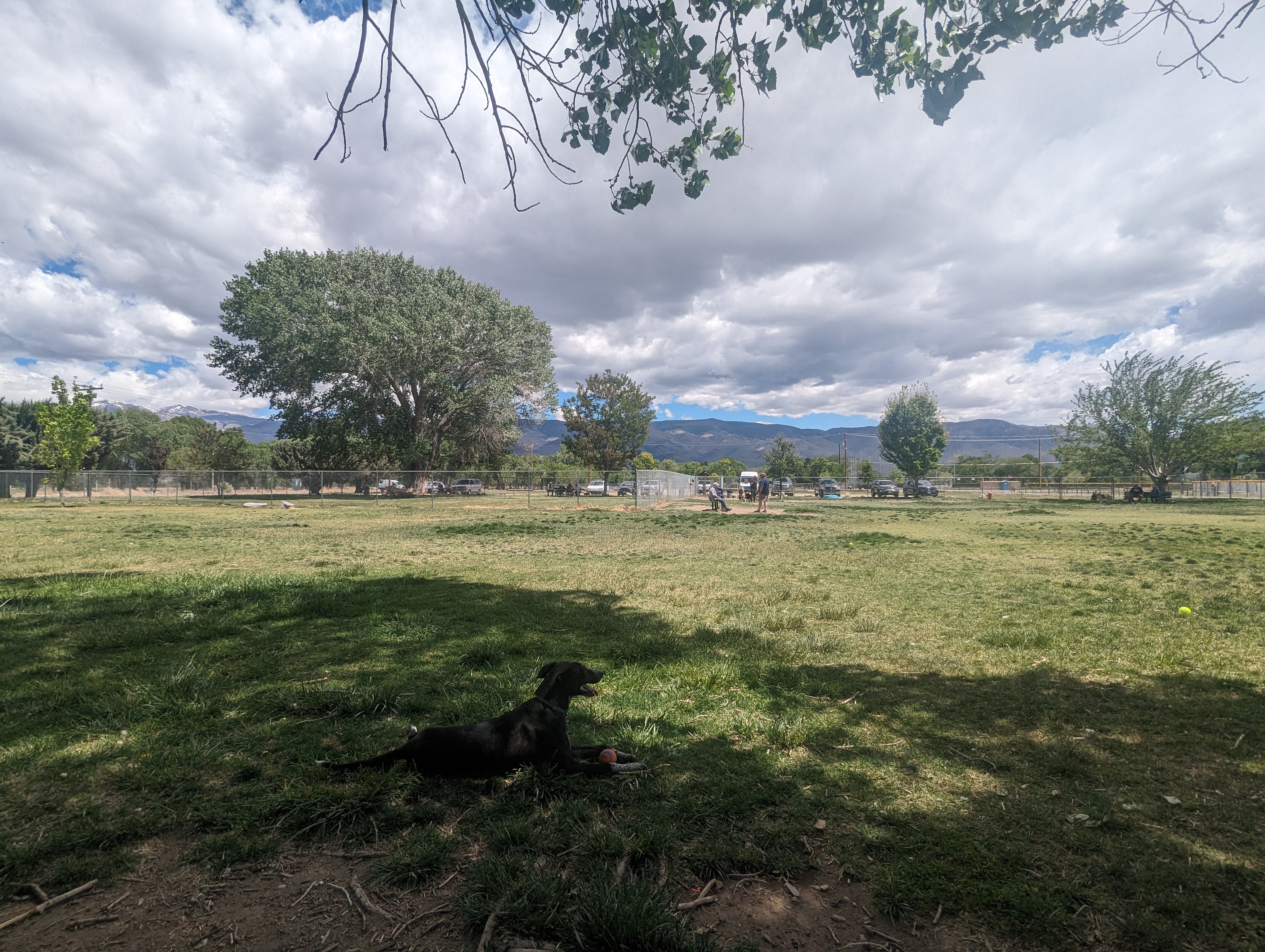
The only thing that really made me cry, that reminded me I was human, was our dog. When I opened his van door, there she was, sitting on the bed.
Her black eyes gleamed with cautious optimism. She wagged her tail once, hesitated, then began to fidget, taking me in. I could tell she recognized me as someone important, but the three months we’d spent together before I left for France weren’t enough to undo her fear of strangers.
As we drove, I heard her jump from the back of the van. She walked to the space between the passenger and driver seats and stood on my legs. I helped her onto my lap, and for a few minutes, she stared out the windshield. Then she craned her neck backward, and suddenly it was an explosion of affection—an overwhelming recognition. She was trying to erase every inch of physical distance between us.
I calmed her down and kissed the top of her head gently.
For a while, it was peaceful. I sat with her on my lap as we drove down Highway 6, heading toward the lot where my van was parked.
And I thought: I could die right now, that would be okay.
When I opened my van door, it was exactly as I’d left it. Clean, a charger I hadn’t needed, a book still on the counter. My life, waiting for me to reoccupy it.
We moved my bags to my own van and I followed him to a nearby bivy. It was classic Bishop, just a random spot in the desert. We had slept in countless places like this, unremarkable but quiet, with no one to bother you, land in all directions.
I unpacked without enthusiasm, opening my van door to watch the last traces of light slip away. Insects rose in the twilight, drifting into the van, but I left the door open anyway.
I threw a ball for Lejla. She bounded toward me, crashing into my body as if to say “You. I know you.”
It was devastating, but I pulled away from the moment, like it was happening to someone else. Even with her right there—my dog, the one I’d waited years for—I couldn’t change my plan. Not even she could reach me. I clung to this distance like a lifeline, like it was proof that I was doing the right thing. Or maybe this is what coming apart feels like.
“So, where do you want to go for July?”
That was our shared life—constant movement, traveling from one place to another. Rock climbing had been the goal at first, but over six years we’d built a life to be envied. And in many ways, it was a dream.
The next morning, I turned to leave. We were in a big space—walking from one end to the other took time. I heard Lejla following me, her paws light and steady. When I reached the small door, I looked at her, and she looked back, her mouth clamped around an enormous ball. I paused, the door halfway open. She hesitated.
Then, mercifully, she turned around and went toward him. She knew I wasn’t the one for her, after all.
I drove for hours, east.
Sometimes, you wish it hadn’t happened to you at all.
It brought pleasure, but you want the feeling gone. It’s made a mess of you.
How lonely I became, lost even to myself.
AUGUST 2024
UTAH
Maple Canyon
Over the course of the summer, I became a bit of a confident wreck.
During the days, I was okay—almost convincing. My mind felt made up. I could focus on the small tasks of daily living, even plan ahead. But most nights, the indecision would return, lingering in the background like an unfinished thought.
There were no tears, no dramatic outbursts—just a sense of distance from my own emotions. It struck me as strange. I wasn’t someone who didn’t cry. In fact, I cried easily and often. A sad voice on the radio or even a song with a hint of melancholy could gut me. Yet, despite the upheaval in my—the objectively emotional turmoil I had put in motion—I remained strangely calm and equanimous.
Maybe it was all too impactful and dangerous to really consider. So everything stayed abstract, floating somewhere just out of reach. I couldn’t give my emotions the weight-the irrevocability-of a physical response.
What troubled me most was the growing feeling that I couldn’t make good on any of my thoughts, intentions. Things I felt so certain of, that had roused some of my most elegant vocabulary I’d ever put together, they all felt shaky and unfamiliar. I re-read my journals and some emails to people I cared so deeply for, where I suggested certain promises. I was struck with how articulate I was, a trait I had always envied in others but never associated with myself. But now I couldn’t stand by any of my words.
Doubt flooded my mind and brought with it a raw loneliness—pure, and ice fucking cold.

Climbing was there for me, though. I could lose myself in the contours of a routine day: Pack, hike, climb, hike, drive. I’d head into Maple Canyon, sweating it out on 80-degree days beneath the severely steep roofs. It was humbling and fun.
I met new people, an entirely different community of climbers. They thought of me as quick and light and funny, maybe even confident. But the truth was that most interactions took effort.
After climbing, I’d drive out of the canyon and park along the Nebo Loop Road, far away from anyone. My rest days settled into a slow, predictable rhythm: working during the day, moving the van to keep the sun from shining directly inside as it shifted from east to west. When the heat climbed into the 90s, I’d cool off by dunking myself in the shallow river.
Sometimes, I’d numb myself with mindless television: Thank god for the Olympics. I became fixated on the idea of starting over—throwing away everything I owned, buying all new clothes, moving to a city where no one knew me. It all felt painfully morose and self-indulgent, like I’d wandered into the pages of some overwrought novel.
Still, it wasn’t all bad. Sometimes, if I put on the right song—a track with a solid bassline—a strange, simple joy would rise up in me, every trace of melancholy falling away as an instinctual delight took over. It made no sense, but I’d dance alone in my van, headphones on, music blasting. I found myself wanting to do this often—music, headphones, dancing—so I did. Even now, writing this down, I feel a little silly, but it felt like the most honest thing I could do. I’d move faster and faster, until I felt as if I were flying clear out of my own body.
As September approached, someone suggested I go to Rifle. It was an obvious choice—a popular climbing destination for solo van-lifers in late summer and early fall. But the thought of it made me hesitate.
Rifle was an intensely social place: roadside access, no cell service, people everywhere. Your climbing was on full display. My discomfort with the idea ran deeper than I’d ever been willing to explain. I knew parts of my hesitation were justified. But, much of me wondered if my reluctance was juvenile—maybe even attention-seeking.
Everyone—literally everyone—insisted that I belonged.
And yet I felt something drop in me as I closed the distance between Maple and Rifle. I didn’t want the pain, it just came over me, and I clenched my jaw as I lurched across that awkward transition from pavement to dirt, at the mouth of the canyon.
SEPTEMBER 2024
COLORADO
Rifle Mountain Park
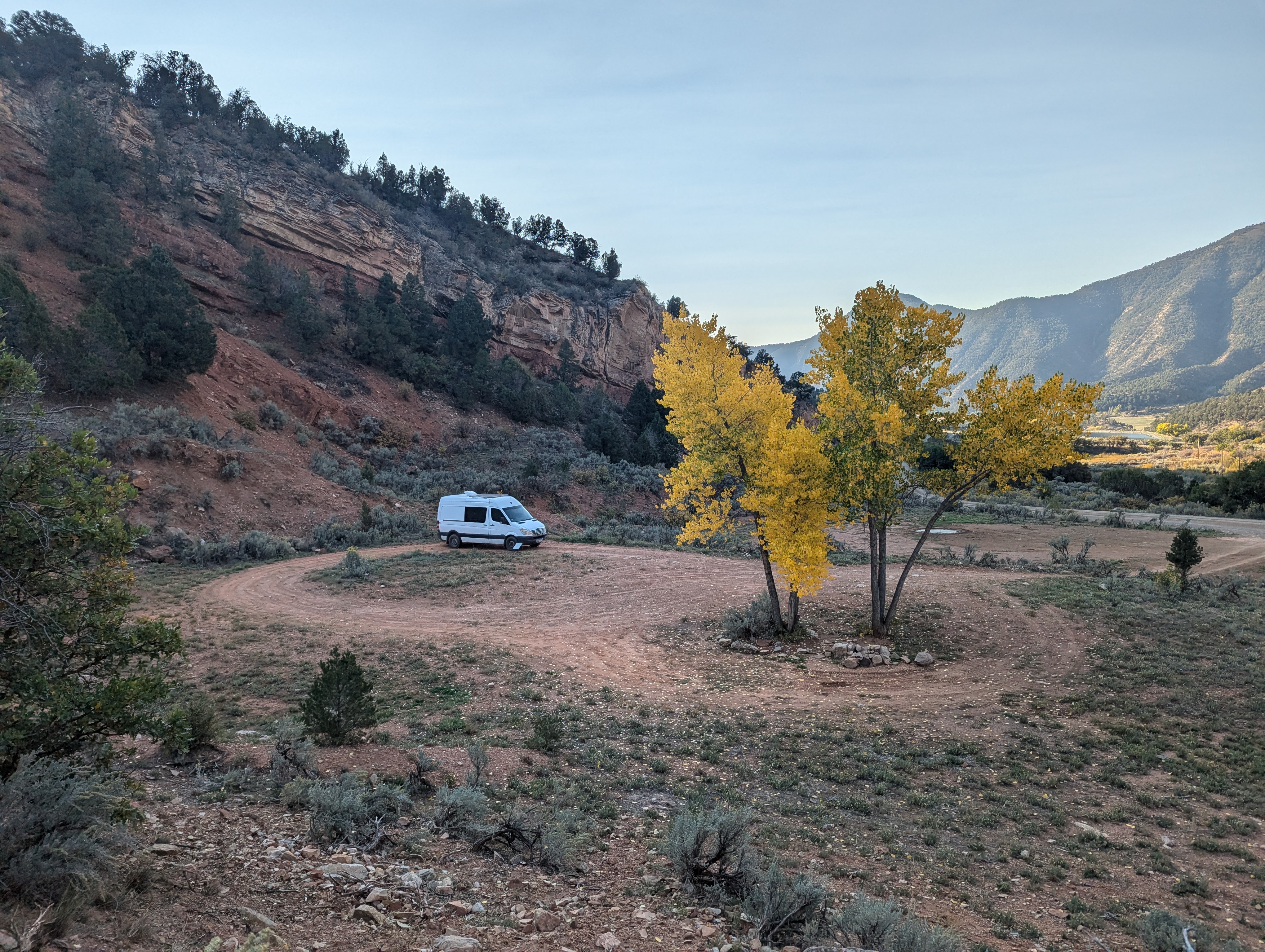
In the first few days, I moved through the canyon timidly, half expecting someone to ask what I was doing there. The air was thick with memories—good and bad. But being here on my own terms felt like a quiet act of defiance, a kind of self-respect I could believe in.
On a particularly steamy day at the Arsenal, I heard a familiar voice: “Is that Jasna?”
Her fiery eyes met mine as she pulled me into a hug, and just like that, four years after we’d met in the canyon, we were friends again.
She was one of the only people I knew who could keep up—who could bat back and forth those sharp, self-deprecating comments without needing explanation. With her, there was no need to spell out the words behind the words—the meaning was already understood. She observed the world in the same way I did. It was easy to be myself around her. And because of that, I did feel welcome. I did relax.
And I even felt myself fitting in, in that unarguable way I’d always wanted.
Roadside Prophet and The Path, Spray-a-thon and Anti Phil. Many more new 5.13s, new 5.12s—I’d forgotten just how much climbing was in this narrow canyon.
On some rest days, I’d take showers at the rec center thirty minutes away, when it was slow and empty. I’d undress, stand in front of the long mirror, and really look at myself. The muscles, defined even at rest. The angles of my face, sharper than I remembered. Driving back, I’d glance at my hands, whose sturdy, masculine build had embarrassed me before. Now, they looked strong and capable. And I thought, I’m alright. Not striking or beautiful in the classic sense, but alright.
For a few weeks, I was happy enough. Life felt almost normal—friends, even dates, a sense of purpose, and climbing, of course. October was unseasonably warm, the heat making the slippery climbing even harder, but part of me didn’t mind it so much. The prolonged summer felt inevitable, as though the long days of sun would stretch on forever, encasing me and my friends in the canyon, a perpetual sunrise.
OCTOBER 2024
DENVER – KENTUCKY
Driving through Kansas, my eyes falling.
The sun dipped below the horizon, and with it, the oppressive heat of the late October day lifted, like a fist slowly unclenching. The landscape softened, bathed in dusky purple, shadows lengthening. Bare branches framed the sky like skeletons, oak leaves clinging stubbornly, fading from green to yellow. A fragile and very unexpected flicker of pride stirred in me: America.
Its vastness, its possibility—it gave me just enough momentum to keep driving.
NOVEMBER 2024
KENTUCKY
Red River Gorge
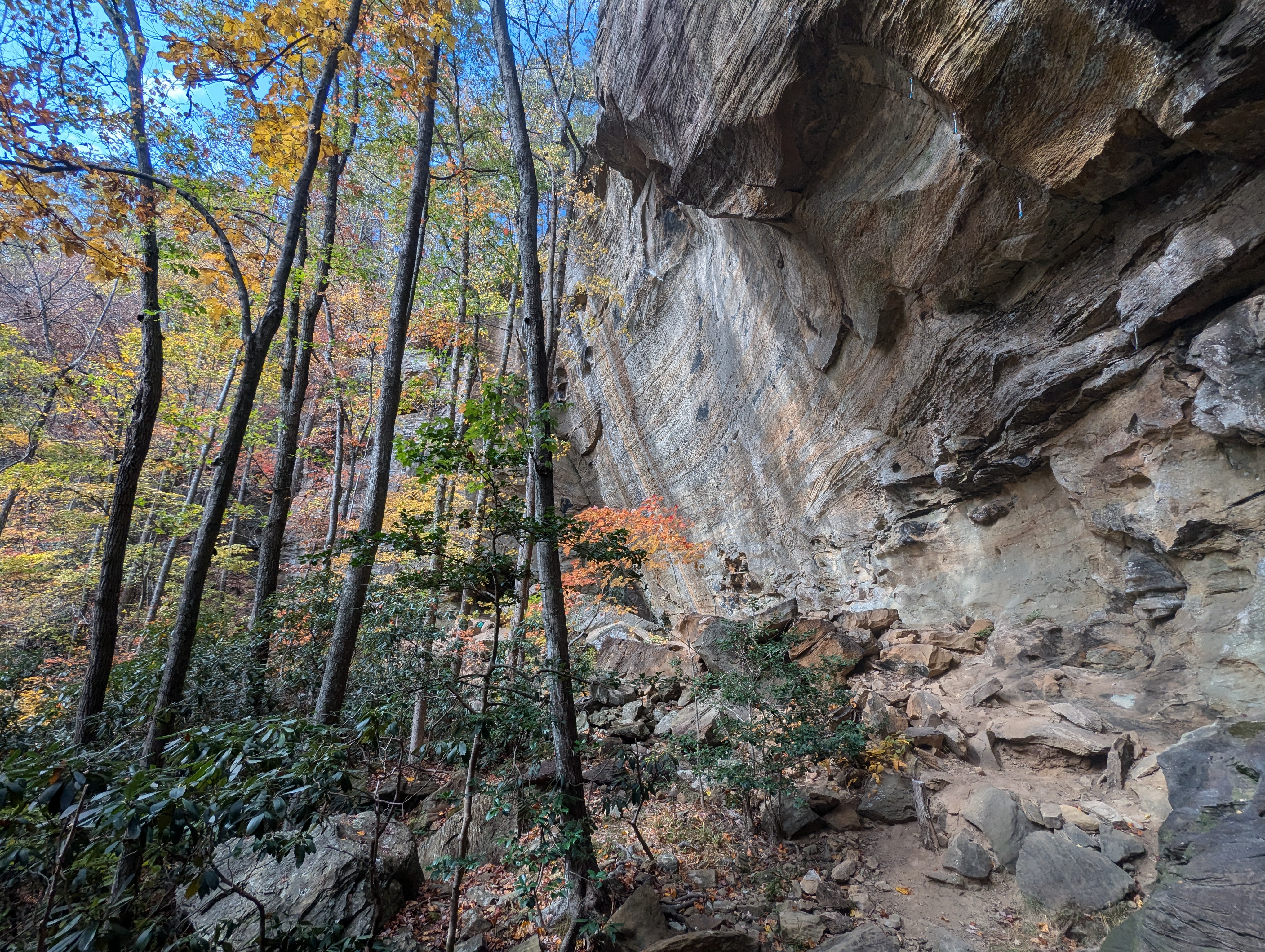
I stumbled into the house where I’d be parking my van for a month during my first trip to the Red. My arrival was abrupt and ungraceful: I’d driven all day, opened the door too fast, and stood there, glazed over, thinking only about one thing—a shower.
At least a dozen necks craned to look at me, all of them sitting on the floor with that casual ease of people who’d known each other a long time. They were friendly, welcoming, and gave me the lowdown. I smiled, nodded, excused myself to shower, and retreated to my van to sleep.
The next few days were awkward in that mild, tolerable way. No one made me feel out of place—it was my own doing. I hovered on the edges, half in and half out, testing the waters of a space that already felt so established. But slowly, I started to find my rhythm, and the awkwardness dissolved so quickly it was almost hard to believe it had ever been there.
I sat on the floor with them, drank cheap wine, and was thrown around the backseat of a truck as we “went mudding” in the woods. The house filled up with more people, and as the ratio of women to men tipped overwhelmingly in one direction, I joked that the “Tech Haus”—named for the software engineers who used to stay there—was more like a sorority. Eventually, we rebranded it entirely. We became the “Cyber Sluts.” It was stupid, but it stuck.
We played trivia on Tuesdays, worked on the crosswords together, danced, occasionally drank, and played pickleball, where we “laid it out on the courts” to Soulja Boy.
The climbing was everything I’d expected—and everything I’d been warned about. The steep walls were a playground, but conditions were horrendous. Thick, humid air left the rock slick and greasy—”jungle condies,” we called it. Then, just as quickly, the weather would snap cold, and we’d be fumbling with numb hands. Still, the shared misery made it better. We laughed at the absurdity of climbing on a 20-degree day, only to strip down to tank tops in the same week.
The Red is intensely popular, and the crowds were overwhelming. The lines for routes were tolerable—I could always find another—but the social pressure tested my resolve. Old habits crept in, the tendency to measure myself against what I perceived others expected of me, what they valued in me.
It was all in my head, but it also wasn’t. Most days, I couldn’t go to the cliff without someone saying “You’re so strong,” or “I’m sure you’ll onsight that,” or , the classic “You’re absolutely jacked.” It wasn’t mean-spirited; it was meant to be flattering. Still, they made me self conscious and stirred a primal fear I’d been trying for years to control: That people only bought into me because of some genetic predisposition I have to build muscle, and because of what that image suggested about my climbing. And worse, I wondered if I’d let it happen, or even helped it along. If the way I looked and climbed was the currency I’d been trading on all along, whether I meant to or not.
Paradoxically, I managed well enough because I had people to distract me. I was very happy to go to climbing, but I equally looked forward to shared meals, a party, working on a crossword on the couch with someone else—the lasting warmth of being part of something that continued long past the day at the crag.
As the jungle conditions turned arctic, with a few golden fall days—or hours, really—scattered in between, my departure date started creeping closer. I felt ready to leave, but I couldn’t help wondering what leaving would mean, or where I would even go.
With people around me, I didn’t sink into melancholy or abstraction as much, and I enjoyed the relief of being present. But I did miss solitude—I felt ready to retreat to my van in the desert. And there was something in that wanting, too: a balance I hadn’t figured out. Other things felt off, like the way I was interacting with old friends, and they way they interacted with me. It wasn’t quite the same as before, a distance that left me sad, regretful, and confused.
As cold, overcast mornings in the 20s became routine, I lingered in bed a little longer. Work had slowed, and if we climbed at all, it wouldn’t be until later—when the temperatures edged upward or the rock finally caught the sun.
I liked the way I thought in the minutes after waking up. My mind was gentler with me—less critical of my contradictions, less indulgent in sadness, and more curious. I had time, now, and I let myself luxuriate in it.
On one side, there was my life as it was: itinerant. An identity I felt somewhat born into. Impermanence that was equal parts painful and familiar.
On the other were the people I wanted to know, some real, others just ideas.
And then, beyond that, there were things I couldn’t write down. Things I couldn’t even admit to myself. Other ways I could choose to live.
And tangled in the middle of it all was me, lying there, trying to rearrange it
To make sense of it
To make space for someone to settle in
DECEMBER 2024
KENTUCKY – UTAH
I was going to Utah because it was December, and I lived in a van. Utah made sense.
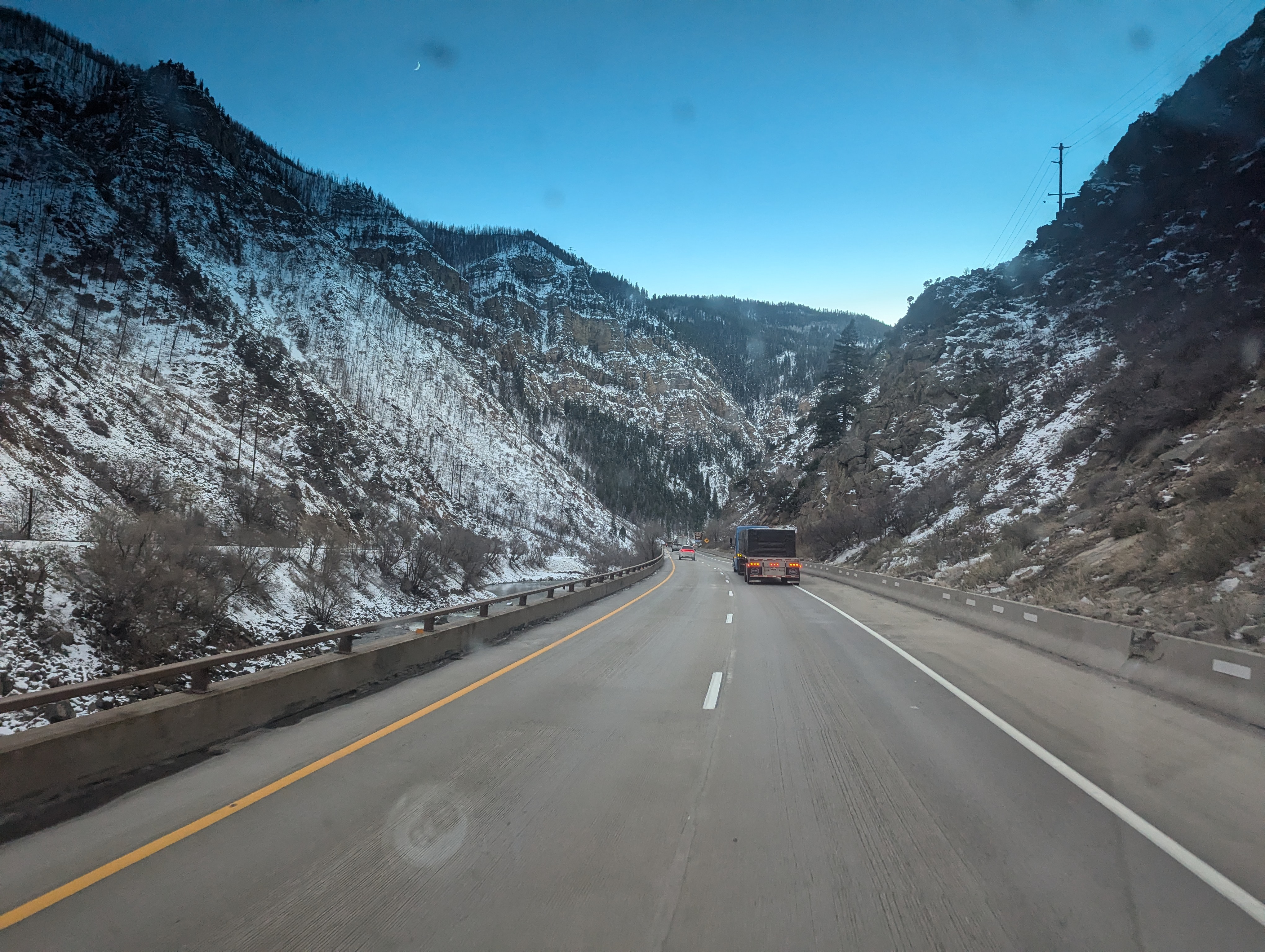
Missouri, Indiana, Illinois—gray, endless, and still. The days barely crept above freezing.
I was a machine. Gas, brake, lights . Stopping to eat, stopping to fill the tank. The door opening, the sharp air rushing in, biting at my face.
Endless pavement, the hum of the tires, the low, constant vibration of the engine beneath me, an occasional jolt from the bump in the road. An ache in my lower back, a crick in my neck.
In Colorado, I stopped. I opened a friend’s apartment door and was struck by how much the sight of him made me feel content. Safe. We got sushi.
I woke up before dawn. It was 12 degrees. I poured hot water over the windshield, steam curling up like breath into the cold air. I could stay here if I wanted.
I drove on.
The crisp, sunny sky turned pleasant, and the temperature crept up to the 50s as I crested the final pass. The pines thinned, gave way to Joshua trees.
Twenty-eight hours is a very long time. By the end I was too exhausted to manage my mind, to curate my thoughts so they didn’t go out of control.
And I was afraid I’d always feel this way: not being one thing, but existing as an endless series of oppositions I could never reconcile.

DECEMBER 2024
ARIZONA / UTAH BORDER
River Rd.
Around that time, I listened to music nearly all day, whenever I could. I felt like I had to rely on artists to make sense of me—Siegfried and Solo by Frank Ocean, Walkway Blues by M83, Hard to Find and Terrible Love by The National. Sometimes, I’d even replay parts of hour-long trance sets I had memorized, certain intervals where the music seemed to pluck a chord inside me. Anything to bridge the tension between my internal and external worlds.
My favorites were the songs with lyrics that weren’t easily understood or interpretable. I felt like I had a camaraderie with these artists—a kinship with those who were wrestling with the inconsistencies of living and trying to hold them down into existence with language.
Merging onto I-15 N, as I neared the spot of desert I’d sleep in for the night, SABLE by Bon Iver came on.
“Things behind things behind things” played.
Over and over, I’d listen, like I had written it.
Why hadn’t I thought of those words?
The fact that someone else did, though, offered some comfort.
Eventually, I pulled off. I felt the pavement turn to gravel, the gravel to dirt, and I stopped in one of the random desert patches I had in mind—one of the flat ones I knew well.
I turned off the engine, and switched the music from my speaker to my headphones. I wanted my brain full of it, that pleasing type of pain. At least it felt significant in some way, attended with a commensurate hope that my objective loneliness was a necessary evil, one that could lead me to a deeper understanding.
I sank into the driver’s seat and looked out the window.
I let it blur together.
My near-sighted vision turned the cars along the Southern Parkway into trembling, soft asters, blinking in and out of existence. Driving away from me. There and gone again.
“I would like the feeling, I would like the feeling gone.
Because I don’t like the way it’s—
I don’t like the way it’s looking.
I get caught looking
In the mirror,
On the regular.
And what I see there resembles some competitor.
I see things behind things behind things.”
Most days, I do wake up sad.
But I make my coffee. I go outside.
I look at the gentle desert hills, the dull, unsaturated sky.
And I think of all the places I’ve stayed and come to know.
Then, I focus on the nuts and bolts of life. This is the best part of my day.
I think about the actions and the events to come. The climbing I will accomplish. The best way to go about it. How good it will feel to drop away again, to have the rock under my skin, to feel the wind lash into me. To work toward that moment where I might get lucky and exist most beautifully. To do it again, and again, and again.
I even begin to consider the future. Moving to Spain, another city, quitting my job—actions I have every power and ability to put into motion.
That’s when I let my little miseries go for a few hours, drop down from the clouds I live in.
Later that day, I rounded the corner toward the Blasphemy Wall for the third or fourth time this season. I looked at it with a slight smile, something like reverence. As if I came here to ask for absolution.
Atonement looked like a slab of concrete, a blank, silver sheet.
But I kept walking. It was a different route this year, and I was still in the delightful early phases of the lifecycle, where progression was consistent and linear. Where I was still learning the beta, surprising myself with small links.
Today, I had a few goals, small checkpoints I wanted to meet. I had written them down. I hoped it would be windy, but not too windy.
It’s not so bad really, this life in gray.
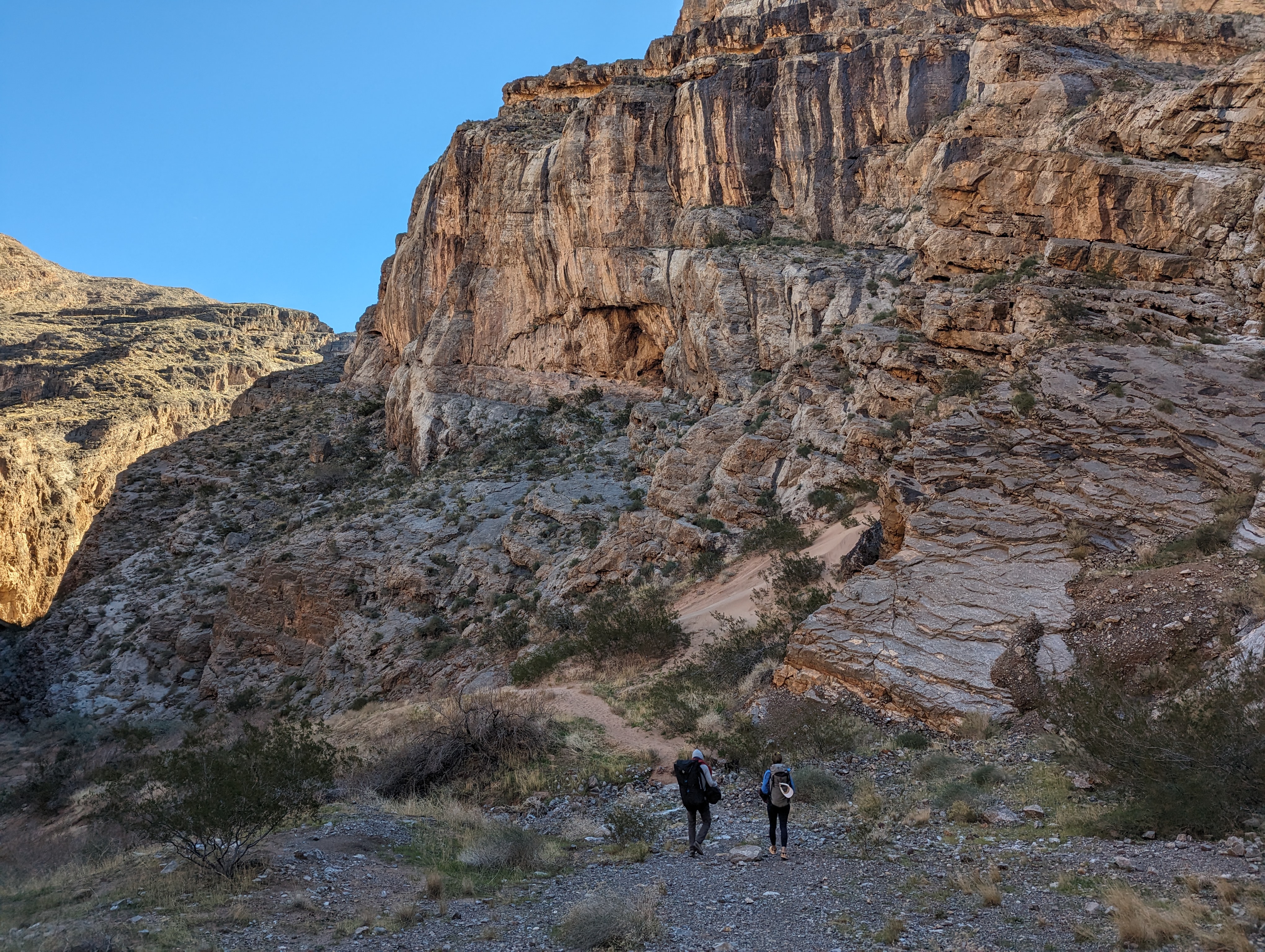
FEBRUARY 2024
ARIZONA
Virgin River Gorge
ELEVEN MONTHS AGO
I was hollowed from the grind of showing up day after day, falling short, and forcing myself to try again. That quiet confidence and belief that it takes to commit, to let go and climb, was in dangerously low reserve.
Normally, I’d push through, force my way past doubt. It had worked before.
But, while my mind could trick my body into performing above its limit, the reverse had never been as reliable.
I took a week away and let the perfect conditions pass. When I returned, the temperatures had climbed—but I’d bet on the wind picking up, as it often does in the desert spring. It hadn’t let me down. I could barely close the car door against the gusts.
The day before, with a rested mind, I’d noticed something new: an adjustment in my foot sequence. Almost imperceptible, but it brought me into the deadpoint position more efficiently—saving a probably meaningless amount of energy and tension as I wound up for the crux. It might have been extremely subtle, but in the scheme of a climbing project, it was also very new, and it gave me something else I could control.
I walked across the slabs, did my warmup, laughed with everyone else there. There was a good crew, some friendly faces from Vegas.
Indeed, the particles in the air seemed to be aligning, nudging the day toward that elusive ‘magic’ category—when the climbing feels weightless, the friction impossibly good.
I went for it.
I climbed through the hardest single move but fell several bolts higher —at the redpoint crux—a precise deadpoint to a square edge. I caught it with three fingers instead of four, and it wasn’t enough to pull me through to the biggest hold on the route, where the 5.14 gave way to 5.13—two bolts of perfect, run-out, bullet-grey limestone.
Before my next try, I walked out to the very end of the cliff, along the slab that jutted over the road. I turned around and took in the wall. I reached for my phone in my jacket pocket and scrolled to my curated playlist. Headphones on, play.
And I closed my eyes for a moment and stepped onto that wild road where my heart led.
It takes a skilled actor to play the part. To assume a role, knowing it’s not real, but committing to it anyway. The risk is going too far and losing sight of yourself.
But if you’re careful, if you can control yourself, the climbing—and everything surrounding it: the preparation, the hike in, the hike out—becomes something else entirely.
It condenses into expression—a meaning you define, that belongs only to you, and that opens into a place no one else can know. For me, climbing was one of the rare times when the weight of what I carried inside—unresolved and only half-understood—took shape in the external world. Through my movement, what I felt became tangible, undeniable, almost proven.
But you have to know what elements you can change around you to rouse this internal state of being. It’s not passive, it doesn’t “happen” to you. It’s a practice, a skill. If you can do it, it’s a little like love—intense, deeply rewarding, and so fleeting that you marvel every time you feel it.
At its height, you’re transcendent, suspended beyond the margins of normal, daily human existence.
It’s completely bogus, it’s an illusion, a contradiction.
But it also feels a little bit like wisdom.
I feel my heart rate rise—I’m nervous. I shrug my shoulders backward—they were fatigued from my last effort. But I focus on the song.
And sure enough, it returns—the spring in my step, the youthfulness I still had.
Then I feel my cheeks lift—a slight, coy smile. An acknowledgement: I’d felt like this before, only to climb again, and fall off somewhere else.
I was in a state. But it was not for the climbing—I had not created or designed it to help me succeed.
Rather, it was an inevitability—an exalted and elemental state of mind, roused by the movement itself: just the right difficulty for just the right amount of time.
And only then, I can fall away from myself
And so far, I haven’t found anything else that will do this for me
Let me out of my own ego
I look down at my hands, lined and dry.
I clench my fist and feel it—a little power left in my fingers
And, eventually, I look back up and walk toward the wall.
 Jasna Hodžić, PhD